Abstraction
Addressing a series of animation experiments undertaken as part of a Medieval Ideas Creative Laboratory Bursary, this paper speculates upon the meaning of the gif in an age of AI driven reductionism. Medieval marginalia, the essay argues, can support an urgently needed political possibility for the gif, via questioning linear media trajectories and discontinuities, inviting engagement with intertextuality, materiality and a return to the rhyming thought, games, meta and sub texts of illuminated and other works, specifically the playful marginalia and parallelism of the 14th century Macclesfield Psalter (c. 1320–30). The essay draws upon a range of theorists and ideas including Thomas Nails’s revival of the Roman Poet Lucretius, as a materialist, visceral alternative to Plato’s second order abstraction. The paper asks, what is the future of the animated gif if we do (or do not) resist the platitudes of AI Slop?
Key words: Gifs, Marginalia, Macclesfield Psalter, Materialism, AI Slop
Frame 1
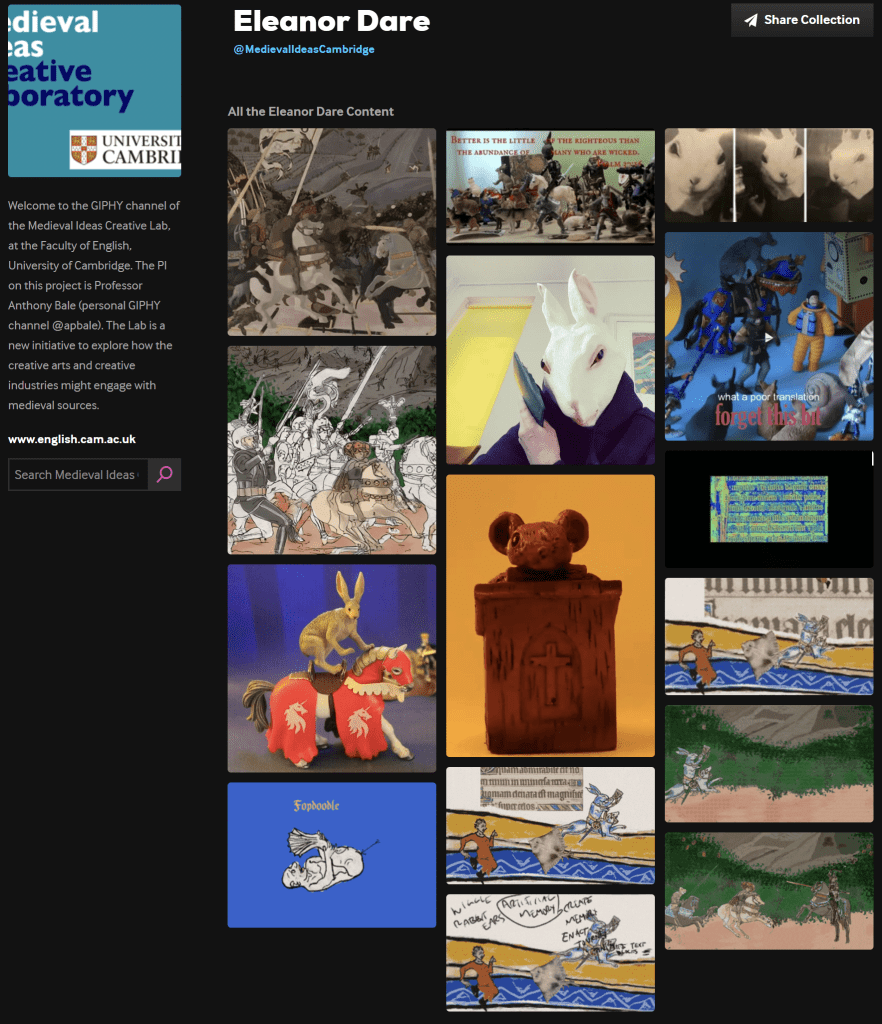
The work discussed in this paper is the result of a digital artist’s bursary which enabled me to explore via drawing, stop motion, 2D and Generative AI animation the continuities, similarities and significant differences between Medieval marginalia and animated gifs. These are contrasted with what is found to be the unsituated and culturally deadening impact of Generative AI images and text under regimes of pervasive political censorship. While there are grave concerns about ‘misinformation, disinformation, deepfakes, bias, discrimination, and cybersecurity caused by malicious uses of AI, censorship by AI has only recently received warranted attention. Addressing this issue is urgent because employing AI techniques results in censorship that is “more precise [and] less detectable.” However, unlike concerns about algorithmic recommendations or misinformation, which form the basis of much AI literacy programming, AI censorship awareness and detection asks not “what am I seeing and why” but ra-ther “what I am not seeing and why?”’ (Ridley et al, p. 170, 2025 ). The practices that unfolded around the question of what we do and do not see arise from twenty years of research into the meaning and impact of text and images created by machine learning converging upon Medieval marginalia via a bursary from the Faculty of English at the University of Cambridge. The bursary was aimed at artists without formal training in Medieval history. The resulting gifs started with experimental, initially quite undetermined drawing and animations, enabling me to find an organic series of non linear research pathways, which inevitably reflected my experiences as a technologist and fine artist. This process stimulated a number of questions, for example:
- What if any continuity is there between Medieval marginalia and animated gifs?
- Will the complexity, nuance and layering arguably present in human-made gifs be eroded by the projected future dominance of AI generated gifs?
- What can we learn from Medieval marginalia and their material and cultural ecologies?
The last question arises from an increasing concern with the extractive impact of mediation, informed by Parikka (2015), Crawford (2022) and Valdivia (2024), as well as a wider sense of urgency re AI, the data centres that make AI possible and their causative connection to escalating climate, social justice and health crises.
While working on the bursary and this paper an important gif API site was shut down. On June 30th 2026, Tenor Gif API which served gifs to sites such as Discord, X/Twitter, was closed by Google (Whitwam, 2026) adding to the sense that it is becoming harder to access all but the most benign or corporate aligned gifs, these are available as in built image banks on WhatsApp, Tik Tok and other social media platforms. As a corporatized form the gif seems banal, it hovers at the compressed, fundamental limits of communication, destined it seems to entropic extinction, frictionless irrelevance as it becomes an increasingly blank format, or on the other hand, a toxic locus for wider corporate propaganda and misogyny (Bentzen, 2026). What might such works become after a few years or even months, is there a way to speculate upon the gif’s destiny by both looking to the future while also looking back at the past? And if the gif’s destiny seems destructively homogeneous, how can we ensure gifs and wider animated images retain their polysemic (carrying multiple meanings), discursive intertextuality and are not replaced with frictionlessness banality or what has become popularly known as AI ‘slop’?
Technically, most if not all contemporary Generative AI images are currently rendered by a dominant Diffusion model, such as that which underpins Stable Diffusion, Dalle-e 3, Bing Image Create and Midjourney. This model inseparably entwines text and images via large language models and embedding of pairs of language and image vectors. Such images are formed via reductionist compression (later re-compressed or decoded) known as dimensionality reduction. In this reductive process the ‘essence’ or most reduced form of an image is represented within layers of compressing neural networks or so called ‘latent space’.
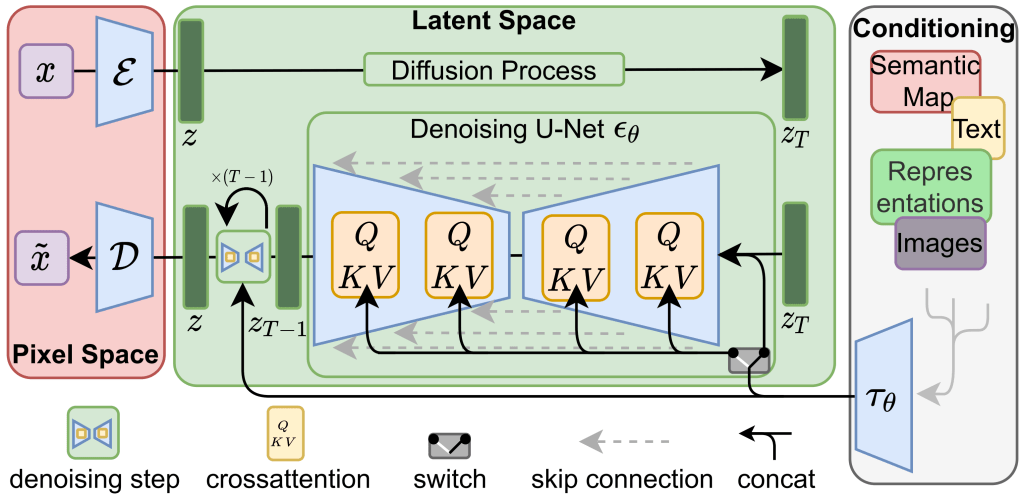
Architecture of Stable Diffusion, Robin Rombach, Andreas Blattmann, Dominik Lorenz, Patrick Esser, Björn Ommer – https://arxiv.org/abs/2112.10752, CC BY 4.0, wikimedia.org
This architecture, like all such large scale systems of probability has a tendency to replicate dominant imagery, cliche and pastiche which emerges as ‘Mean images’ , after Hito Steyerl’s play on words (2023), images which are mean, as in statistical regression to the mean and mean in form and culture, as in stolen. Combined with the probabilistic ‘bag of words’ in which most likely (and therefore most dominant) patterns of words, parts of words and combinations are predicted, Generative AI, including so-called multimodal (text and image) architectures are highly conducive to low quality pastiche or what I will refer to throughout this paper as ‘slop’ and ‘AI slop’ (Hern et al, 2024).
A less intuitive aspect of Stable Diffusion architecture is the denoising or reverse diffusion process in which visual noise is first generated and layers of neural networks in tandem with the CLIP language and image vector embeddings enable neural networks to iterate through statistical processes in order to generate a trained concept, meaning numerical coordinates (vectors) of things, qualities, aesthetics or ‘style’ which match a text prompt. All such neural networks rely upon a degree of random (stochastic) initiation, such as random weights to prevent identical outputs and ‘vanishing’ or ‘exploding’ gradients, as neural networks iterate through data to optimize learning (see Salvaggio, 2026 for a detailed description and critique of this process as ideological).
The autoencoder (which processes dimensionality reduction and decompression) is as ideological as it is technical writes Salvaggio, it ‘is supposed to stand in for a perceptual subject position, but its capacity for evaluation and comparison is entirely shaped by the commercial web’s visual hierarchy. This is a sneaky ideological operation: the autoencoder occupies the structural position of a perceiving eye without meeting that position’s subjective demands. The discernment of a human body is replaced by the quantified crudeness based on what passes the commercial web’s sorting logic. The crude decision is inscribed in vector geometry, equating perception with the act of evaluating plausibility – but at best, it asks: does this image look like an image? At each step, the picture of a dog becomes more dog-like because it is being compared against an absence of dog, represented by blurry or noisy patches remaining in the image’ (Salvaggio, p. 6. 2026)
Unlike generative AI images, Wagener claims the (pre AI) gif is post digital, offering an unprecedented complexity of semantic knots. Even a cursory glance at Medieval marginalia and their often contradictory context of religious texts and absurd subversive, power inverting images points to the enduring generativity of animated and animating images, suggesting the way to enact a renaissance of kinetic materialism in the interdiscursive margins. Created in 1987 by CompuServe engineer Steve Wilhite, the GIF ‘is an image file format that used lossless data compression. What set the GIF apart from other static image formats such as the JPEG or PNG was its additional support for looping sequences. The GIF can display frames on repeat within the same image file without being the size (or resolution) of a video. For the early web, the GIF was an ideal way of adding visual content and movement to a website at a time when bandwidth was limited and video and image-editing software were less advanced’ (Miltner et al, 2017). Highfield et al remind us the gif is nearly 40 years old, a file format that:
enables the endless looping of image sequences: the animated Graphics Interchange Format (GIF). Whether it is isolating and sharing the “Hillary Shimmy”, texting a reaction GIF of NeNe Leakes from The Real Housewives of Atlanta or remixing Sean Spicer with a clip of Homer Simpson disappearing into bushes, the GIF is a remarkably dexterous, malleable, and versatile file format that is central to digital cultures and communication (Highfield et al, 2017).
But the contemporary gif is now predominantly found lurking in the pre-made menus of smartphones, with branded identities and what seems like zero political edge or cognitive challenge. As a form the gif invokes our emotional labour via casual cuteness, anthropomorphising laughs and dance crazes rendered with frogs and floppy eared bears. The corporate gif offered by WhatsApp or Teams seems infantilizing, easy to swallow but not culturally or conceptually satisfying. Memes and gifs, writes Wagener, are ’postdigital utterances: they show how distinctions between human and technological, and between predigital and postdigital, have become blurred, messy, and subject to ‘bricolage’ ‘ (Wagener, 2020). The modern branded gif accelerates our loss of attention, our collective cognitive decline (Kosmyna, 2025). In 2026, the gif’s logical partner is Generative AI, the kind epitomised by the notorious Coca Cola adverts of 2024-25.
Remembering the AI Christmas Coca Cola advert scandal, in which it reputedly took more than 70,000 prompts to produce an unremarkable image of festive pastiche is a much needed reminder in the face of ceaseless hype that Generative AI is inefficient, representing a false promise of productivity. Generative AI is unable to reliably produce a coherent image let alone a sequence of coherent images without splurging gallons of water and finite fuel (Mouriquand, 2025).

My several years of experiments with Generative AI animation (often as part of funded research and practice) has entailed repeated waste, looping efforts to combat the lack of consistency generated by architecture and algorithms which rely on a combination of stochastic and probabilistic processes resulting in hands that slip into a mass of crabs, animals morphing into curtains; absurdity and pastiche which makes a mockery of the term ‘prompt engineering’. A materialist ontology of images, on the other hand, as Nail reminds us, incorporates a:
fundamental connection between materialist physics and ethics. If ethics begins with a materialist philosophy, it will avoid the abstract immaterial traps of immortality, the good, and morality that lead to suffering: the hatred of the body, hatred of matter, and the hatred of motion. If people believe there are static moral duties, virtues, or values, other than what their bodies can do, then they will end up hating their own (and others’) immoral bodies (Nail, 2018).
Pre AI gifs are in some ways technically simple, yet complex in their polysemy, ‘largely because they are isolated snippets of larger texts. This, combined with their endless, looping repetition, allows them to relay multiple levels of meaning in a single GIF. This symbolic complexity makes them an ideal tool for enhancing two core aspects of digital communication: the performance of affect and the demonstration of cultural knowledge’ (Miltner et al, 2017). As AI generated animations break rapidly, losing coherence, it seems inevitable that their ability to generate only a few seconds of imagery means the gif and AI slop will soon be married, affect and cultural knowledge will live happily ever after for a few seconds until they violently collapse into chaos. If the corporate gif now lacks the postmodern irony or glitchy edge it had in 2016, the AI slop gif is even worse, lacking context or meaningful connection, velocity is its main qualitative function and form. Such velocity is a slipping mask for the chaos machinic Neoplatonism cannot suppress (Nail, p. 18, 2018).
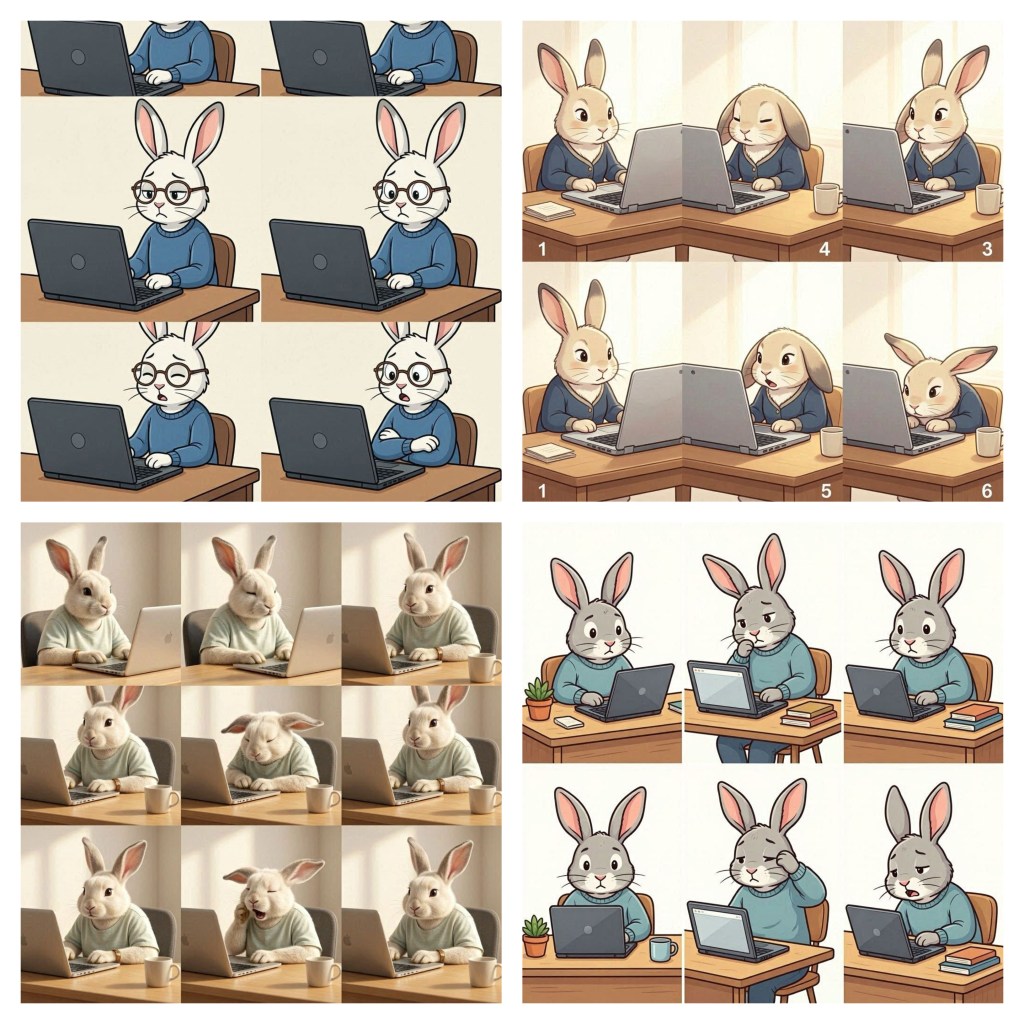
Learning from the Macclesfield Psalter and wider Medieval suggests media can maintain and sustain a level of complexity and kinetic metastability in which ‘matter flows indeterminately, then folds up and cycles into metastable objects, and is then distributed with others into fields’ (Nail, p. 13, 2021). Such metastability is wittingly or unwittingly being undermined by corporations, as they descend into regression to the mean and eventual inertia, exemplified below via an image sequence created with the Bing Image Create Platform, using the MA-Image-2e model, ‘Vivid Storytelling’. The prompt used was to generate ‘a series of images of a rabbit working at a computer and looking bored, for an animated gif, no background, do not clip the laptop off the screen’.
The application did not understand (or rather enacted a series of erroneous inferences) the prompt through several iterations, making the images unusable and certainly not fulfilling the platform’s stated promise to ‘Transform Ideas into Reality with AI Creations’ (Bing, 2026), it also repeatedly miscounted the frames adding meaningless figures not required in the prompt. It represents an absence of functional stability as opposed to Nail and Lucretius’s imminent metastability. The AI generated gif, unlike the pre AI gif and marginalia represents looping chaos.
Towards the end of the AI generated sequence, the rabbit grabs a fistful of coffee from the air, revealing the algorithm has statistically inferred the rabbit’s yawn as a preparation for drinking. I find these types of ‘misunderstanding’ less irritating than the attempts to render ‘cuteness’, but do not think this would be useful in aiding me in creating non ironic animations, though there are of course other uses of these algorithms and other ways to render scenes with machine learning. I am using mass media approaches here that are available via phone apps and ‘easy to use’ online platforms often described as ’democratizing’ (Masi et al, 2025) despite their inefficient inconsistency and deskilling banality (Lenharo, 2026). The use of such platforms has logically informed much of my solo and collaborative research into AI images and texts, though I have used less high-level approaches to critical AI animation such as Python coding for animations in projects such as the AI Musement Park, and the participatory play, Monstrous (both part of MozFest 2023). Some of my students (and worryingly, even some colleagues) have uncritically accepted a corporate narrative of AI as enabling a ‘democratized’ access to animation, illustration and film making processes. I find this wholly disingenuous given the economic and environmental costs and inefficiency of Generative AI. It feels ever more urgent to investigate such claims by practice and theory and to also incorporate critical investigation into the teaching and practice of digital media and wider digital humanities. But I am also committed to providing alternatives and subverting the dominant narrative of AI inevitability and the idea that it is part of a putative ‘evolution’ conveniently entangled with the needs of multi-billionaires.
Frame 2
In spite of the likely descent of the corporatized gif into monosemic chaos my hypothesis is upbeat: Medieval marginalia affirm the likelihood of enduring semantic and material knots of complex intertextual networks. I disagree with Wagener that only the post digital (albeit entangled with the pre digital) embodies such complexity and invite us here to explore the possibilities marginalia activate and to go even further back to Lucretius’s materialism (and before that to all animating and animated images) as affirmation of a materialist philosophy, as a counter to the hatred of the body, hatred of matter, and the hatred of motion Nail invokes via Lucretius (2018). My experiments started and ended with the Macclesfield Psalter, currently held in the Fitzwilliam Museum, Cambridge.

A psalter is a book of psalms, which seems straightforward, but as Jones states, the Macclesfield Psalter evokes a ‘confused devotion, in which even a terrifying personification of death is juxtaposed with a man falling off his horse, and a nude pisses into a bowl held by a character whose head is connected to his arse’. Jones frames the Psalter as a form of Social Imaginary in which:
The attraction of the Macclesfield Psalter lies in its ordinariness rather than uniqueness. For all the brilliance of its artist, who had mastered the exquisite, sensitively shadowed delineation of the nude human body, and who showed boundless creativity in weaving words into images and images into letters, it is as a fragment of a mental world that this manuscript is so seductive. This, in the end, is the appeal of Medieval art – the imagination of an entire society channelled through the conventions of craft (Jones, 2005)
As Jones describes it, the Macclesfield Psalter evokes an animated movie: ‘abundant in the bizarre and grotesque monsters, the comic incident and everyday scenes that Medieval artists loved to insert in books. The Christian social order stood on its head in these ludicrous follies that set off the beautiful letters. You see details of leaves, grazing herds, hogs and birds, a ploughman and the unlikely friendship between rabbit and hound’ (Jonathan Jones, 2005). Such psalmic parallelism creates what are called thought rhymes, for example synonymous lines which reinforce the same image or idea as in Psalm 19:2:
Day to day pours forth speech,
and night to night declares knowledge
But also antithetical parallel verses which evoke tension and contradiction, synthetic lines building on each other, climatic lines leading to a conclusion, emphatic verses, repeating words with similar meanings, such as heart and soul and eclectic lines, entangling heterogeneous imagery (Bratcher, 2018, Siegel 1985). Parallelism provides a juxtaposed presentation of narratives designed to subvert, critique, interject or reinforce ideas but also to establish memories. In relation to memes Wagener calls this interdiscursivity:
an infinite space which allows speakers to rely on different layers of discourse and discursive utterances, which are all intertwined and layered in various forms. For instance, when we speak, we do refer to various discourses that have been existing before us or that are linked to actual matters, and that constitute social reality (Howarth 2000). Memes are interdiscursive per se: they may combine various references and concatenate them in order to compress layers of interdiscourse into a new form of discourse. That new form of discourse should be considered through a systemic view (Wagener 2019).
Wagener’s semantic knots, ‘represent the main meaningful meeting points within discourses, are entirely dedicated to the postdigital universe and its intertwined blurring of online and offline interactions as well as predigital and postdigital phenomena, while being also based on pop-culture, shared references, and the common need to express feelings and ideas. Such semantic knots (Wagener 2018: 45) operate as meeting points that allow meaning to emerge for individuals’ (Wagener, 2020). Semantic knots ‘gather a variety of clues that are collectively put together by individuals in order to decipher, understand, and propagate messages. Thanks to memes and GIFs’ high level of intertextuality, such semantic knots may gather an incredible amount of meaningful clues: text, interdiscursive operations, pictures that can be remixed, and, in the case of GIFs, dynamic videographic elements that can replace simple pictures’ (Wagener, 2020). But this kind of gif is arguably under threat from corporate gatekeeping and dominance but also from the dead end of AI model regress, such that Instagram does not allow the gif format without it going through the obtuse wall of the mystifying Giphy platform. WhatsApp provides its own anodyne gifs, which, in theory, can be replaced by those created by others, but who now creates original edgy gifs in sufficient numbers to impact our doom scrolling? The semantic possibilities and small signifying networks passed between individuals Wagener described in 2020 are in danger of being short circuited by prepacked and culturally limited corporate gifs. However, even this dreary triviality may be imminently undermined by the marriage of the gif with AI slop, necessitating a reorganisation, in which ‘when the communication modes of a system change, it has to reorganize itself entirely in order to reach a new stability’ (Wagener, 2020) reminiscent of Thomas Nail’s ontology of metastable, kinetic images (Nail, 2018). What form such reorganization might take is hard to predict, perhaps we will see a counter reformation, a form of analogue resurgence, an undercommons of hand made gifs, emerging from the margins of mediation.
Frame 3
Nail reminds us that we often think of images as mental representations, arising somewhere within ‘our brain (in our minds) which is a copy or resemblance of the world outside. I think that’s not right, there’s definitely something going on but that’s a very narrow way of thinking about what an image is. An image is a real thing, it is something that happens in our eyes and in our brains, that is related to the external world, but that is a tip of an enormous iceberg. That’s the part that we see on the surface. Below the surface of the water is this enormous process of the rest of the world, of the enormous processes that we don’t actually see which are part of the fabric of the world and forms and media that we use, and it’s very active. What we have in our brains is not a copy of the world, it is the world itself just by other means. It is a continuation of the world inside of us just. It’s not a question of resemblance but interactivity, of performativity (Gonzarek, 2019).
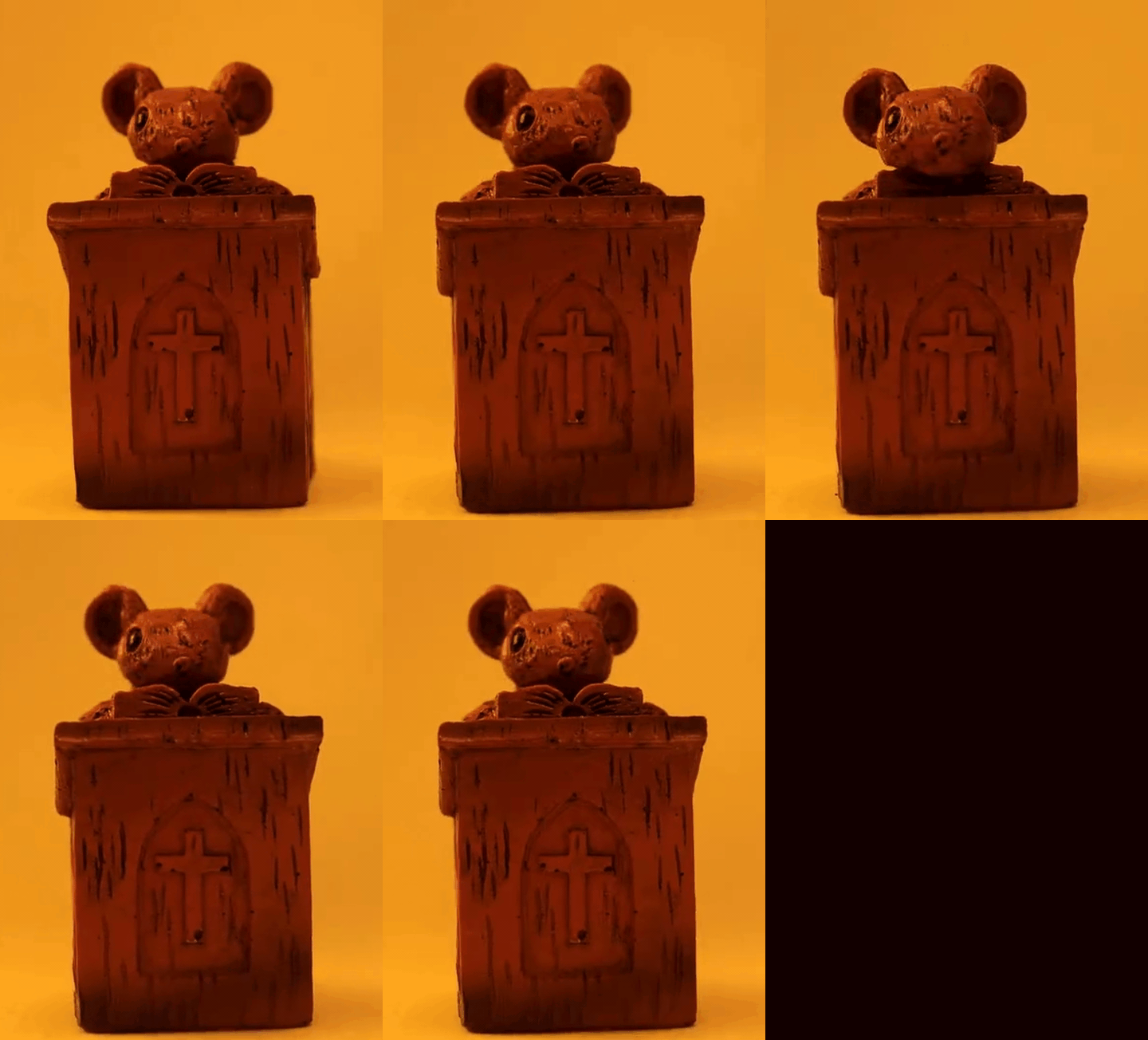
This evokes the complex materialist, interdiscursive and kinetic relationships with readers, objects and ideas found in the Psalter’s hyper materialism, which draws us into a world we interact with by reading and looking and sensing, chiming with Nail’s observation that ‘although we often experience vision as a passive thing that sort of happens to us, but that’s actually very active both in our bodies (in our eyes the way they seek out, move and follow and respond to the world). One of the main takeaways was to think about much larger context what an image is but also what the world does‘ (Gonzarek, 2019), Nail states:
‘Lucretius was perhaps the first in the Western tradition to forcefully argue for a completely materialist, immanent and naturalistic ethics based on moving well with and as nature. If we want to survive and live well on this planet, Lucretius taught us, our best chance is not to struggle against nature but to embrace it and facilitate its movement’ (Nail, 2020).
Nail concurs with Deleuze, that the reversal of Platonism necessitates ‘showing the true chaos repressed within Platonism itself in the form of the simulacrum or pure dissimilitude, or difference, which is the condition for the division between model and copy’ (Nail, p. 18, 2018). The chaos repressed within Platonism is manifest time and time again in AI generated text and images, though it is easy to forget this as we are bombarded by opposite corporate narratives, promising us an AI driven efficiency and reliability where there is in fact no such possibility in a world of finite resources and irreducible complexity – AI instead brings chaos.
Like AI and cryptocurrency the gif has had its ups and downs, including a resurgence in 2016 aided by ‘the nostalgic proclivity of Internet culture groups for the banalities of the early web: dial-up modems, cheesy Web 1.0 design, and 8-bit pixelation. Even though GIFs are capable of supporting higher image quality, the low-quality GIFs of the early web form part of the “Internet Ugly” aesthetic beloved by early users of the Internet’ (Highfield et al, 2017). Combined with Generative AI however, the era of ‘ugly’ polysemic gifs may be supplanted by something more sinister, as we face model collapse, extremist propaganda and the convergence of power to those who seek monopolistic media control, we will see also a tendency towards slop derived from slop, meaning the worst possible detritus of probability based social media production and semantic implosion. In 2018 Researchers at the MIT media lab trained a model they named ‘Norman’ on ‘image captions from an infamous subreddit (its name is redacted due to its graphic content)’ (MIT Lab, 2018). The Norman model would interpret innocuous ink blots as acts of brutality and murder, in fact anything the Norman model processed would be interpreted as having a video nasty intensity of violent horror. There is little documentation of the project, which seemed designed to reinforce the construct of ‘data bias’, deliberately using extreme data as if it was a niche form of representation and not, arguably the violence which constitutes the ideological and material basis of extractive AI industries (whose violent impact on the environment, workers and communities living near data centers and lithium mines is now well known, see Valdivia, 2024, and Crawford, 2022).
Frame 4
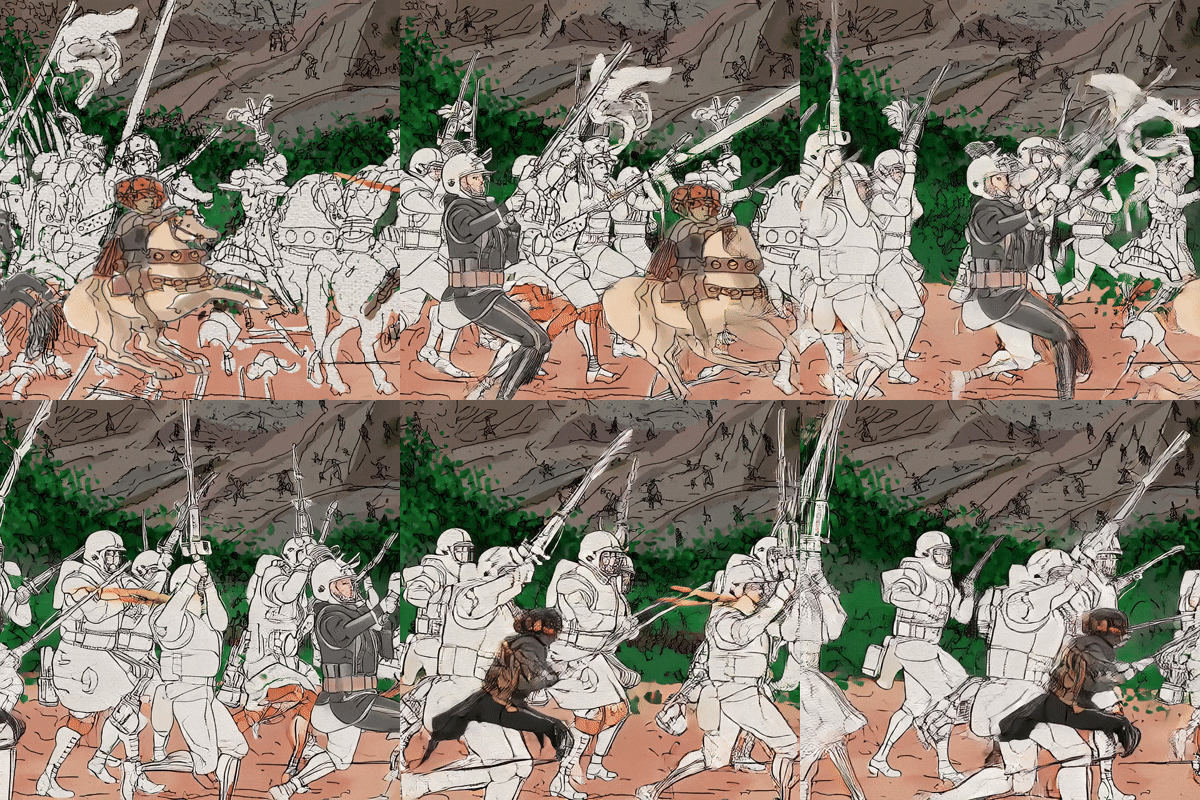
So, now, eight years after the MIT lab’s experiment with ‘Norman’, what happens when we undertake a similarly risky process, marrying slop with the gif ? The Veed Video Diffusion Model software I used to conduct my first Norman type experiments started with my attempts at hand drawing Uccello’s Battle of San Romano (a Medieval painting I have been interested in for decades). Within a few seconds of inputting my drawing into an image to video application with the prompt, ‘soldiers going into battle’ it was animated into a crassly violent, splattering brawl, each frame exuded video game levels of aggression, above and beyond the idea of ‘biased’ data sets. Much like wider game culture, it manifested a childish fantasy of conflict, like Musk challenging Zuckerberg to a cage fight (Thomas, 2023), fantasies ungrounded by lived experience of actual violent labour or physical discomfort. On the other hand, Uccello’s original painting does not animate violence in this way and is instead still, materially grounded, presenting us with a moment of intelligent reflection within a very carefully constructed formal space. Uccello does not invoke a need for ‘more masculine energy’ as Zuckerberg infamously does (Mahdawi 2025), but the gif generated with image to video software seems to fulfil that intention, contrived and ontologically questionable as it is. This and other AI animations seem deadeningly bereft of vitality, lifeless for all their movement, limited compared to the images in the Medieval marginalia and Uccello’s Battle of San Romano.
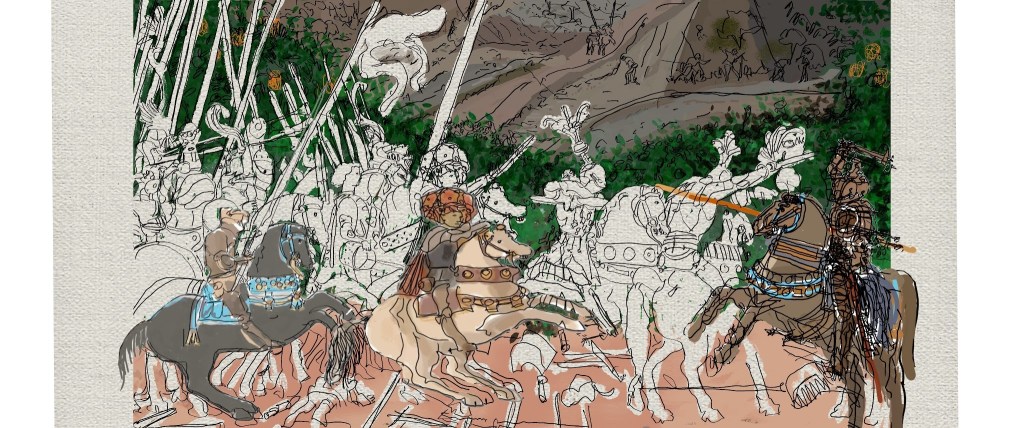
My drawing of Uccello’s Battle of San Romano processed by the Veed AI image to video software becomes a gun-laden modern battle scene with paramilitary weapons and uniforms, revealing the dominant patterns of representation such systems draw upon. Impett notes how poor AI systems are at representing pre photographic and pre Fordist culture, ‘imagine trying to adapt these algorithms for early modern European painting; it becomes clear that the categories of objects being detected (e.g. Polaroid Camera, iPod, Model T), and indeed the very notion of object detection, are bound up with a (post-) Fordist image world in which pictures are largely made up of industrially manufactured consumer goods, rather than, say, Albertian istorie (narrative painting)’ (Impett, 12, 2024).
The cultural complexity of gifs arises from their intertextual interdiscursivity in which ‘Memes and GIFs are complex elements of meaning, so understanding them requires systemic studies and discursive theories. Due to their use of multiple semiotic utterances (language, image, video), memes and GIFs are intertextual and interdiscursive (Garric and Longhi 2013). They are intertextual, because they implicitly borrow from other texts and references while displaying a new message’ (Wagener, 2020). They are also, according to Wagener, interdiscursive, ‘because they implicitly combine various language conventions (discourses, styles, and genres) in order to convey a new message in creative ways (Jorgensen and Phillips 2002). Memes and GIFs can be involved in interactional power relationships (Flammia and Saunders 2007), inasmuch as they can be used by political and economic organizations to convey meaning through original and creative content. They are thus subject to negotiation, manipulation, and instability, just like any other system of signs’ (Wagener, 2020). But the danger of corporatized Generative AI gifs is the opposite, a shutting down of discourse, a convergence to corporate monologic which does not allow for marginalised communities, ideas or discourse but panders to the nationalistic, the conservative, the dominant (Nicoletti et al, 2023). This is not metastable or polysemic, it is, I would argue, at best an entropic cultural dead end. Censorship, or ideological intervention by AI systems makes rendering a satirical image of say, Trump or Putin a violation of terms, see images below, while at the same time abusive uses, such as AI assisted ‘undressing’ are not censored by unregulated platforms, including until January 2026, Elon Musk’s Generative AI ‘tool’ Grok (Illori, 2026). This leads to a situation where political satire is shut down and sexual exploitation is facilitated. Polysemy is curtailed and monotonous, toxic misogyny and racism are encouraged by far right gate keepers of Generative AI. However, it has to be acknowledged that some AI generated political meme gifs do get through to Giphy and the now closed Tenor API, images of Trump as a streetwalker, a fat woman, a taco, and on the other hand those he has apparently generated himself, such as a Trump Christ healing the sick. The use of Generative AI memes by the far right perhaps proves Audre Lorde’s adage that ‘The master’s tool will never dismantle the master’s house’ (Lorde, 2007).
The difference between polysemy and monotony, between situated culture and probabilistic, ‘mean’ logic becomes clearer in investigating the phenomena of antithetical parallelism. During the bursary I became aware of the idea of parallelism and its subtypes via the Macclesfield Psalter, as well as the idea of psalmic thought rhymes and what seem like subtexts enacted via the materiality of the book itself.

Above, prompts refused by Bing Image Create, Microsoft’s AI Diffusion based image generator
Frame 5
Medieval illuminated manuscripts groan with ornaments, with gold and precious blue pigments, and like modern gifs some of it is offensive, racist, puerile, funny or just unfathomably weird. Gifs, according to Wagener ‘compress and reduce immediate meaningful references in order to be easily replicated, shared, and understood, thus engaging into a compressed approach of discourse (Torfing 2005), culture and language—an ultimate polysemic compressed form of meaning. This particular discursive emergence uses its own reduced system of signs and references (Cannizzaro 2016), based on a heavily interdiscursive nature—hence the strong mixture of cultural references’ (Wagener, 2020).
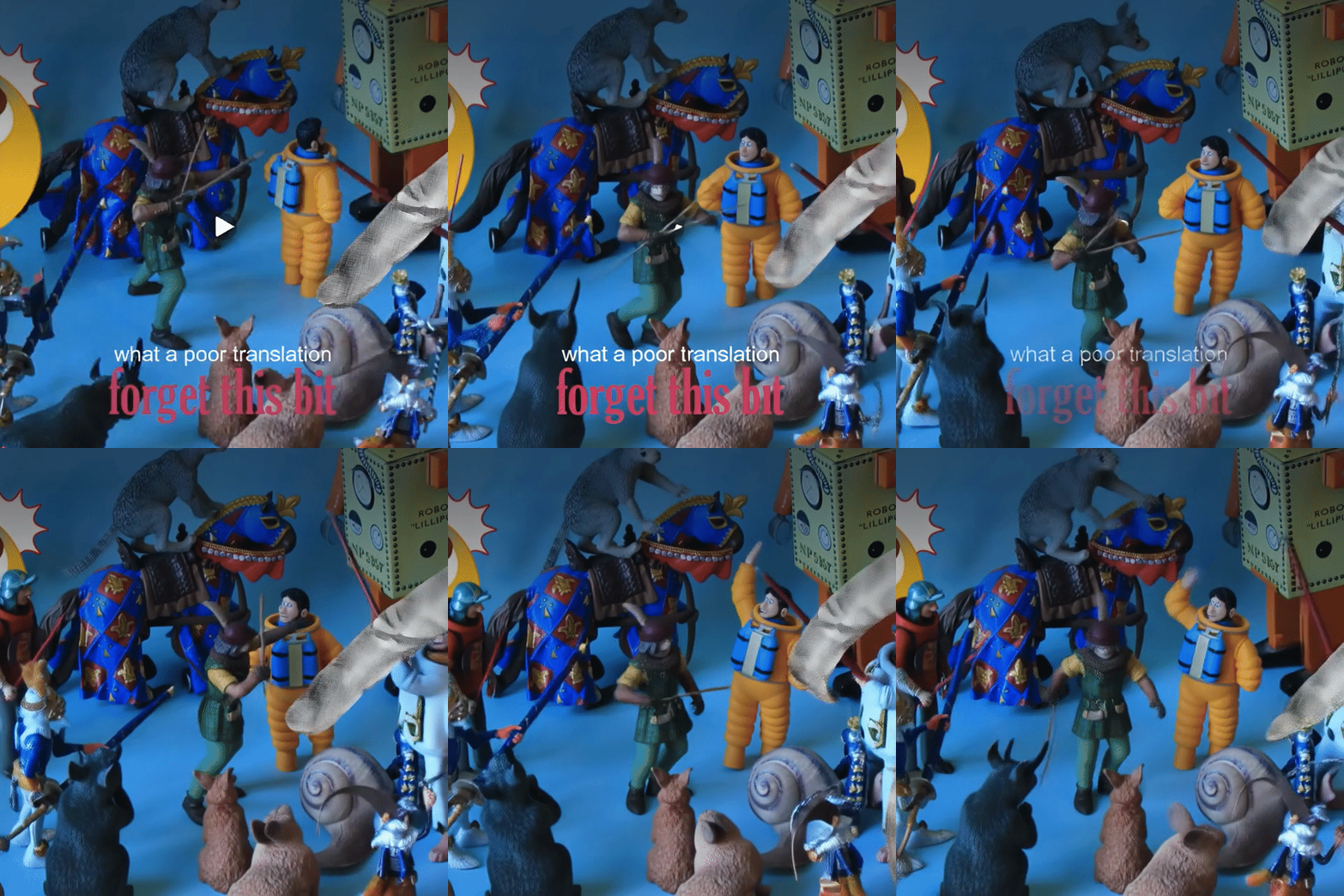
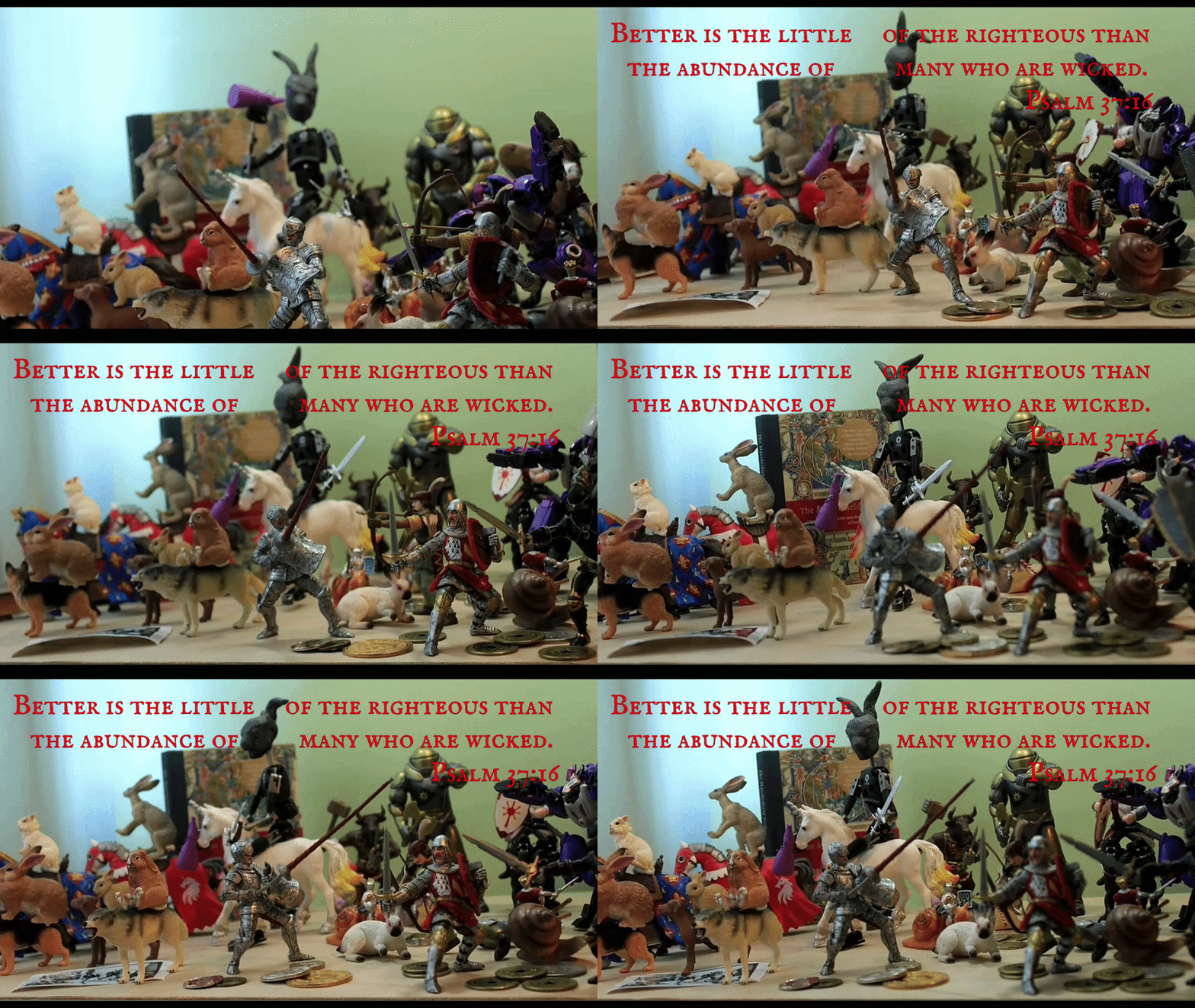
Like marginalia, AI slop gifs cannot easily be separated from language, even image to image interfaces draw upon language embeddings such as CLIP, meaning they are inherently intertextual at a technical as well as a cultural level. The gif image above was created to explore cultural intertextuality via stop motion animation of toys (and an armature) and the Psalm 37:16, ‘Better is the little of the righteous than the abundance of many who are wicked’, it features righteous poor rabbits, horses and dogs and wickedly abundant human aggressors. This is my understanding of antithetical parallelism in the Macclesfield Psalter, a contrast of ideas. It interests me that Large Language Models seem to have a tendency towards the robotic repetition of this type of antithetical parallelism, in the form of ‘not X but Y’. I have even seen complaints about it on social media:
‘The two biggest culprits that make AI generated copy hard to read is the over reliance on two key writing styles:
Anaphora: where each sentence starts with the same word in a rhyming pattern.
Antithetical Parallelism: it’s not X, it’s Y.
ChatGPT is the worst for this but most AI does it.
(Gordon, n.d).
Gordon suggests deploying an explicit negative prompt not to generate antithetical text parallels as a solution, but I am not convinced this would work judging by my previous experiments with lipograms. Large Language Models (LLMs) do not follow rules well, instead they forget the rules you give them and revert to probability. Unlike LLMs, The Macclesfield Psalter embodies memory over probability, indeed much of the imagery is highly improbable. Mary Carruthers writes:
Manuscript decoration is part of the painture of language, one of the gates to memory, and the form it takes often has to do with what is useful not only to understand a text but to retain and recall it too (Carruthers, 281, 1990).
Such complex threads of commentary and cognitive intervention have made me rethink my own assumptions about Medieval texts and images as simple, dogmatic or one dimensional. The Macclesfield Psalter was produced in East Anglia around 1330, when East Anglia ‘was one of the foremost artistic centers of Europe. The margins are populated with charming, often bizarre illustrations, combining religious imagery and depictions of everyday life with bawdy humor and grotesque creations. In this fantasy world, men are attacked by giant snails and enormous fish, while rabbits joust, play the organ or ride dogs’ (BBC Online, 2014). The Psalter invites multiple entry points and ideas, providing intertextual animated images which are marginal and potentially subversive. This is not the same as the rote repetition of antithetical imagery and ideas we see in text generated by large language models, to the extent that such monotonously predictable parallelism is now a pseudo intellectual ‘tell’ for AI assisted plagiarism (Stockton, 2025).
Frame 6
In many of the gifs created for the bursary I have tried to enact the inversion of power structures and meta-fictional margins and memory devices the Macclesfield Psalter marginalia deploy. Evoking the rhyming thought of parallelism found in the Psalter has been an illuminating visual and animation challenge, but also the echoing motives, metaphors, zoomorphism and animism/personification of objects with thoughts, which has a perhaps surprising resonance with posthumanism. While not all gifs are memes or memetic, the framing by Zanette et al has been useful, they identify key themes by:
investigating memes as material artifacts that have agency in themselves. Second, studying memes under the lens of rhetorical theory, considering their function (Miller, 1984) and their interaction with the Internet as a medium (Lanham, 1993, 2006). Finally, looking at memes as performative objects (Harju & Huovinen, 2015; Thompson & Üstüner, 2015) that have a linguistic function and also reflect tensions that defy/reify power structures found within the prevalent consumer collectivities online (Zanette et al 2018).
Materiality, rhetorical theory of function, mediation, linguistic function and performativity, seem like useful ways to understand the gif. This also chimes with Nail’s ontology of the image and of what we see in the Macclesfield Psalter, to merely say it is ‘interactive’ is to underestimate the apparent intention to enact a cognitive function, to change the thought processes and therefore the materiality of readers or watchers themselves (if one is a materialist and not a dualist, that is).
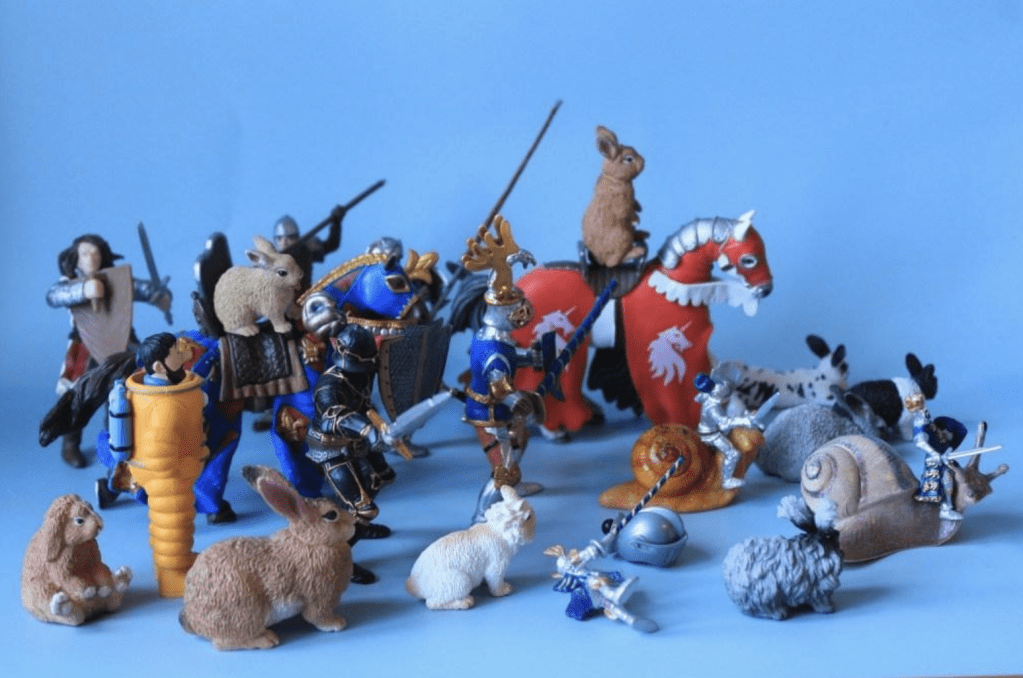
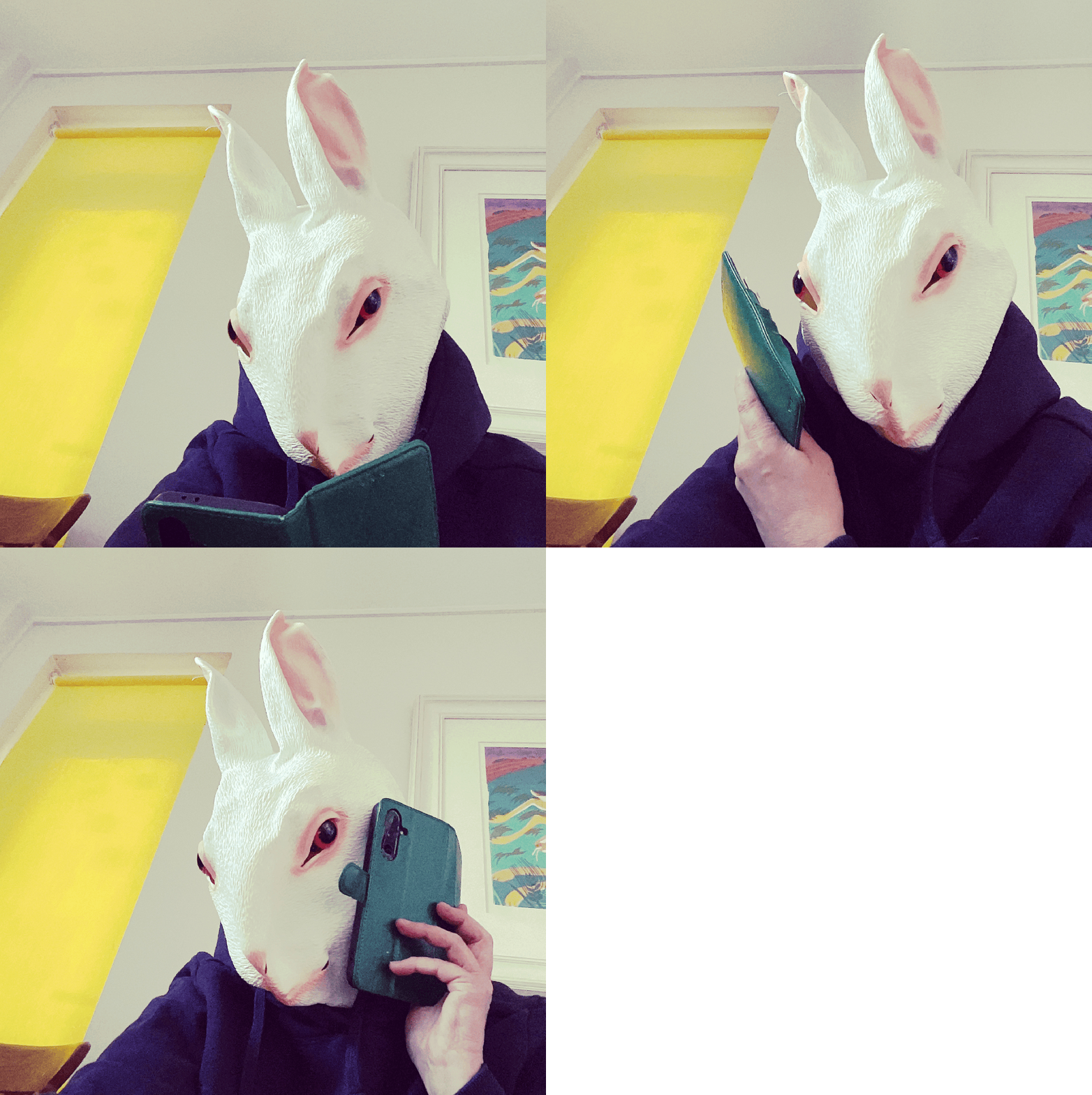

To be clear, I am not using Generative AI as a ‘tool’ or because I think it is better at drawing or thinking than I am (I do not), rather it is present in some of this work as an opportunity to interrogate the ideologies of vision and memory present between and within the 14th to the 21st Centuries as a form of parallelism and antithetical parallelism. I have also been part of a number of funded research projects investigating AI, specifically large image data sets used to create models for Generative AI (the AI Forensics project, 2024-2025, PI Leo Impett), and the Digital Good project, 2023-2024, PI, Dylan Yamada-Rice), in which we investigated children’s attitudes to AI. I also convene and teach on data schools at the University of X which address the material, social and educational implications of AI. Impett and Offert suggest the need for new methods of investigating art history, taking ‘into account the epistemic entanglement of a model and its applications’ in recognition that ‘the visual ideologies of research datasets and training datasets become entangled’ (Impett & Offert, 2023). While working with these Medieval images, texts and animations I have been confronted by the broader ideological nature of visual culture and the assumptions embedded in this moment of Generative AI saturation. AI technology is almost always presented as the peak of technological advancement and sophistication, but the Macclesfield Psalter and other such ‘multimedia’ texts challenge this assumption, in particular the sophisticated meta-texts of the marginalia, which address critical, operational and religious discourse while also augmenting the psalms, instigating heightened mechanisms of memory and intertextual games.
Questions of industrialization and complex supply chains for art production are also raised by these illuminated manuscripts, contradicting our common conception of linear narratives of progress and extraction, particularly in terms of mediation. The gif is of course, ironically, even when mediated via machine learning, a highly reductive form, the actual gif, unlike a page from the psalter is low on complexity rather than offering the escalated technological layering and multiple cultural resources required to produce the Macclesfield Psalter, with its layers of psalmic text, gold and azure illumination, underpinned by marginalia serving multiple purposes from the religious, the cognitive, satirical to the philosophical. This is not to dismiss the complex material ecology of the platforms and devices which channel and support the gif, such as servers, cables, workers, fuel and water, minerals and pipelines, laws and borders which Monserrate (2022), Alexander (2025-26) and Valdivia (2024) write about. Materially, like the internet and machine learning, the Psalter is implicated in complex hierarchies of power and production. It seems there were at least two artists and an assistant, the Macclesfield Master and an Anointing Master involved in production of the text and illuminations. But we must also acknowledge the complex supply chains for paper, pigments, inks, gold and minerals. Such extractive organization led Lewis Mumford to locate the origins of industrialization and the abstraction, quantification and wider ideological shifts necessary for industrial scale production in the Middle Ages (Mumford, 1963) rather than originating in the 18th and 19th Centuries.
The Psalter is on the brink of a change which arguably takes us to the present moment, in which, as McQuillan reminds us ‘Data science is not simply a method but an organizing idea’ (McQuillan, 2017). McQuillan states:
Data science is powerful, because it is an apparatus in the sense that Foucault sets out: a specific set of material and conceptual techniques that coerce by means of observation, ‘an apparatus in which the techniques that make it possible to see induce the effects of power, and in which, conversely, the means of coercion make those on whom they are applied clearly visible’ (Foucault 1988). Data science is an apparatus engaged in the production of subjectivity. While its claims to ontological authority are unsound, a retreat to purely discursive critique loses the power of performativity and drops the material aspect of the philosophy. We need a way to work with the materiality of data science with a different effect. We seek to mobilise the specific constraints and opportunities in a way that extends participation and agency instead of reinforcing dualism and hegemony (McQuillan, p. 267, 2017).
The Macclesfield Psalter offers us in its complex absurdity and contradiction a counter to the industrializing neo platonic ideologies it was networked with; this counter invites, as McQuillan, Nail and many others suggest, not least Barad (2007) a way to work with materiality, intertextuality, agency and participation.
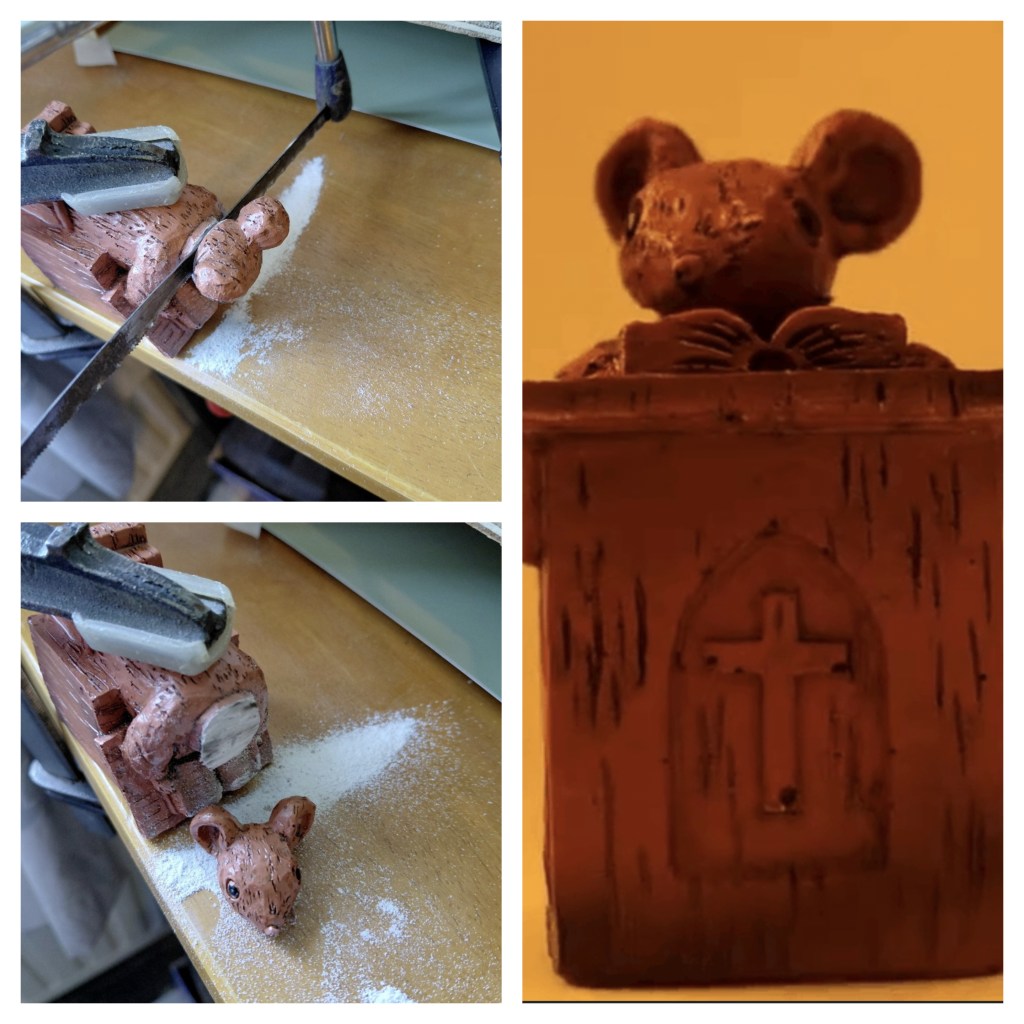
Might the gif similarly act as a locus of political possibility, at this moment of escalating extraction and million giga watt data centres, privatised nuclear power stations fuelling the Generative AI hype cycle? The complex Medieval constructs of thought rhyme and parallelism instigating multiple simultaneous chains of association, memory, metaphor, antithesis and allegory still have subversive potential. Looking forward, the next stage of this project is to invite others to interdiscursive enactment with this potential via stop motion animation, tableaux vivant and pixilation (human animation) in two upcoming workshops. My goal is that we might enact and further explore the potential for subversion, animation and complex kinetic discourse which I have learnt about from drawing and animating the Macclesfield Psalter and the Battle of San Romano in an age of fast and shallow machinic Neoplatonism.
References
Alexander, Anne (2025-2026) The AI Arms Race, substack.com.
Barad, K. (2007) Meeting the universe halfway: quantum physics and the entanglement of matter and meaning. Durham: Duke University Press Books.
BBC Online (2014) ‘The Macclesfield Psalter, a History of the World/ objects’ BBC Online .https://www.bbc.co.uk/ahistoryoftheworld/objects/_ab31pVtQzClDL56jMuROQ
Bentzen, Naja (2026) ‘Women in the age of AI-enabled disinformation’, European Parliamentary Research Service.
Brachter, Dennis (2018) ‘Parallelism in Hebrew Writing’, crivoice.org, available at: https://www.crivoice.org/parallel.html
Carruthers, Mary (1990) The Book of Memory: a study of memory in Medieval culture, Cambridge University Press.
Crawford, Kate (2022) The Atlas of AI, New Haven, CT, Yale University Press.
Facsimile Finder (2026) Macclesfield Psalter,https://www.facsimilefinder.com/facsimiles/macclesfield-psalter-facsimile
Fitzwilliam Museum (2026)FolioThe Macclesfield Psalter Discovery.
Gonzarek, B.A. (2019) ‘The Nature of Digital Image, A Conversation with Thomas Nail’ (transcript), philosophyofmovement.com, available at: https://philosophy-of-movement.com/2019/11/04/the-nature-of-digital-image-a-conversation-with-thomas-nail-transcript/
Gordon, Stu (n.d) Facebook post,https://www.facebook.com/groups/evolutionunleashedai/posts/26545093385111728/#
Highfield, T., Miltner, K. M. (2017) ‘Never Gonna GIF You Up: Analyzing the Cultural Significance of the Animated Gif’, Social Media+ Society, 3,1-11.
Hern, Alex, Milmo, Dan (2024) ‘Spam, junk … slop? The latest wave of AI behind the ‘zombie internet’, Guardian Online, Sun 19 May 2024.
Illori, Tomiwa (2026) ‘The Human Cost of Unregulated AI Tools. AI companies have a responsibility to respect human rights’, Human Rights Watch, February 16, 2026.
Impett, Leo (2024) ‘Digital Art History as Critical AI’, The Art Bulletin, 106(2), 11–14.https://doi.org/10.1080/00043079.2024.2296270
Impett, Leo, and Offert, Fabian (2023) There is a Digital Art History,https://arxiv.org/abs/2308.07464
Jones, Jonathan (2005) ‘The birth of British art’, Guardian Online: https://www.theguardian.com/artanddesign/2005/jul/28/heritage.art?CMP=share_btn_url
Lorde, Audre (2007) Sister Outsider: Essays and Speeches. Ed. Berkeley, CA: Crossing Press. 110-114. 2007
MIT Media Lab (2018) ‘Norman’, MIT Media Lab https://www.media.mit.edu/projects/norman/people/
Nataliya Kosmyna, Eugene Hauptmann, Ye Tong Yuan, Jessica Situ, Xian-Hao Liao, Ashly Vivian Beresnitzky, Iris Braunstein, Pattie Maes (2025) ‘Your Brain on ChatGPT: Accumulation of Cognitive Debt when Using an AI Assistant for Essay Writing Task’,https://arxiv.org/abs/2506.08872
Lenharo, Mariano (2026) ‘Is AI ruining our skills? Early results are in — and they’re not good’, Nature.
Li, Siyi & Pessoa Serafim, Flavia. (2025) ‘Revolutionizing Cinema. How AI is Democratizing Production and Deepening Creative Content’. Connessioni remote Artivismo_Teatro_Tecnologia. 10.54103/connessioni/28718.
Mahdawi, Arwa (2025) ‘Unleash your masculine energy the Mark Zuckerberg way!’, Guardian Online, 18th January, 2025.
McQuillan, Dan (2017) ‘Data Science as Machinic Neoplatonism’. Philos. Technol. 31, 253–272 (2018) https://doi.org/10.1007/s13347-017-0273-3
Monserrate, Steven, Gonzalez (2022) The Cloud Is Material: On the Environmental Impacts of Computation and Data Storage. MIT Case Studies in Social and Ethical Responsibilities of Computing, no. Winter 2022 (January).
Mouriquand, David (2025)”Real magic’? Coca-Cola’s AI-generated Christmas ad sparks widespread backlash (again)’, https://www.euronews.com/
Mumford, Lewis (1963) [1934] Technics and Civilization. New York: Harcourt, Brace & World.
Nail, Thomas (2018) Lucretius I, An Ontology of Motion. Edinburgh University Press.
Nail, Thomas (2019)Theory of the Image, Oxford University Press.
Nail, Thomas (2020) ‘Philosophy Professor’s New Book Lucretius II: The Ethics of Motion’, liberalarts.du.edu.
Nail, Thomas (2021) Theory of the Object. Edinburgh University Press.
Nicoletti, Leonardo, Bass, Dina (2023) ‘Humans are Biased, Generative AI is Even Worse’, Bloomberg, June 9, 2023
Parikka, Jussi. (2015) A Geology of Media, University of Minnesota Press.
Ridley, Michael and anderson, avram, Censorship, Artificial Intelligence, and AI Literacy: Responding to New Challenges in an Enduring Agenda for Libraries and Librarianship (April 02, 2025). Available at SSRN: https://ssrn.com/abstract=5295294 or http://dx.doi.org/10.2139/ssrn.5295294
Salvaggio, Eryk (2026) ‘The Market in the Model: Latent Diffusion as Neural Economy’, Computers and Society.
Shannon, C.E. (1948) ‘A Mathematical Theory of Communication’. Bell System Technical Journal, 27, 379-423.
Steyerl, Hito (2023) ‘Mean Images’, NLR 140/141, March–June 2023, DOI: doi.org/10.64590/uhm
Stockton, Blake (2025) Don’t Write Like AI (1 of 101): “It’s Not X, it’s Y”, blakestockton.com. April 16th, 2025.
Thomas, Daniel (2023) ‘Zuckerberg says Musk ‘not serious’ about cage fight’, BBC News Online, 13 August 2023.
Uccello, Paolo (1438-1440) Niccolò Mauruzi da Tolentino at the Battle of San Romano, left panel (probably c. 1438–1440). Tempera with walnut oil and linseed oil on poplar, 182 × 320 cm. National Gallery, London
Valdivia, A. (2024). ‘The supply chain capitalism of AI: a call to (re)think algorithmic harms and resistance through environmental lens’. Information, Communication & Society, 1–17.https://www.tandfonline.com/doi/citedby/10.1080/1369118X.2024.2420021?scroll=top&needAccess=true
Wagener, Albin (2020) ‘The Postdigital Emergence of Memes and GIFs:
Meaning, Discourse, and Hypernarrative Creativity’, Postdigital Science and Education
Whitwam, Ryan (2026) ‘Google kills Tenor GIF API, forcing changes at X, Discord, and more’, Ars Technica, 30th June 2026.
Yanardag, Pinar, Manuel Cebrian, & Iyad Rahwan (2018) ‘NORMAN: World’s first psychopath AI’, MIT Media Lab.
Zanette, Maria & Blikstein, Izidoro & Visconti, Luca. (2019) ‘INTERTEXTUAL VIRALITY AND VERNACULAR REPERTOIRES: INTERNET MEMES AS OBJECTS CONNECTING DIFFERENT ONLINE WORLDS’. Revista de Administração de Empresas. 59. 157-169. 10.1590/s0034-759020190302.

