This bursary is an opportunity to invite people to engage with medieval and contemporary visual cultures via arts practice so that we learn something new about our diverse understandings of intelligence (and its perceived absence) and it’s long standing relationship to wider historical, animal and material forces.
As a starting point I started to create an animated atlas of medieval and modern depictions of smartness (and its visual antithesis), asking via these images how our senses and ‘smartness’ are depicted in medieval imagery and what are the significant differences or similarities to our contemporary systems of visual representation? During this research I became aware of the idea of Parallelism and its subtypes, such as antithetical parallelism, my work began to investigate the ways in which multiple narratives and technologies were deployed in the Macclesfield Psalter (Fitzwilliam Museum, 2026), the main focus of my research.
The animations here aim to address tensions, concurrences, anomalies, orthodoxies and novelties in the way we visually conceive of intelligence between the Middle Ages and now in the 2020s. Via workshops I propose to hold online and in person at Cambridge Digital Humanities, audiences and workshop participants are invited to learn about and respond to images of intelligence (and its absence), from medieval churls, scholars and fighting snails to contemporary images of human and artificial forms of intelligence.
My work draws upon collections within Cambridge’s museums, religious buildings, colleges and archives, and also the National Gallery, London, curating a selection of images that engage audiences and form a focus for me to select ideas, metaphors and characters which people find amusing, informative, resonant or somehow important.
“Created in the mid-fourteenth century, the lavishly illuminated Macclesfield Psalter represents the height of English Gothic illumination in East Anglia. Its pages are rich in marginal imagery that surrounds the sacred text of the psalms with irreverent and sometimes obscene imagery. No page is left without decoration, and few are without swathes of gleaming gold. The product of a workshop, the hands of several artists known from other works are evident here including the Anointing Master, the Macclesfield Master, and the Douai Psalter Assistant.”
(Facsimile Finder, 2026)
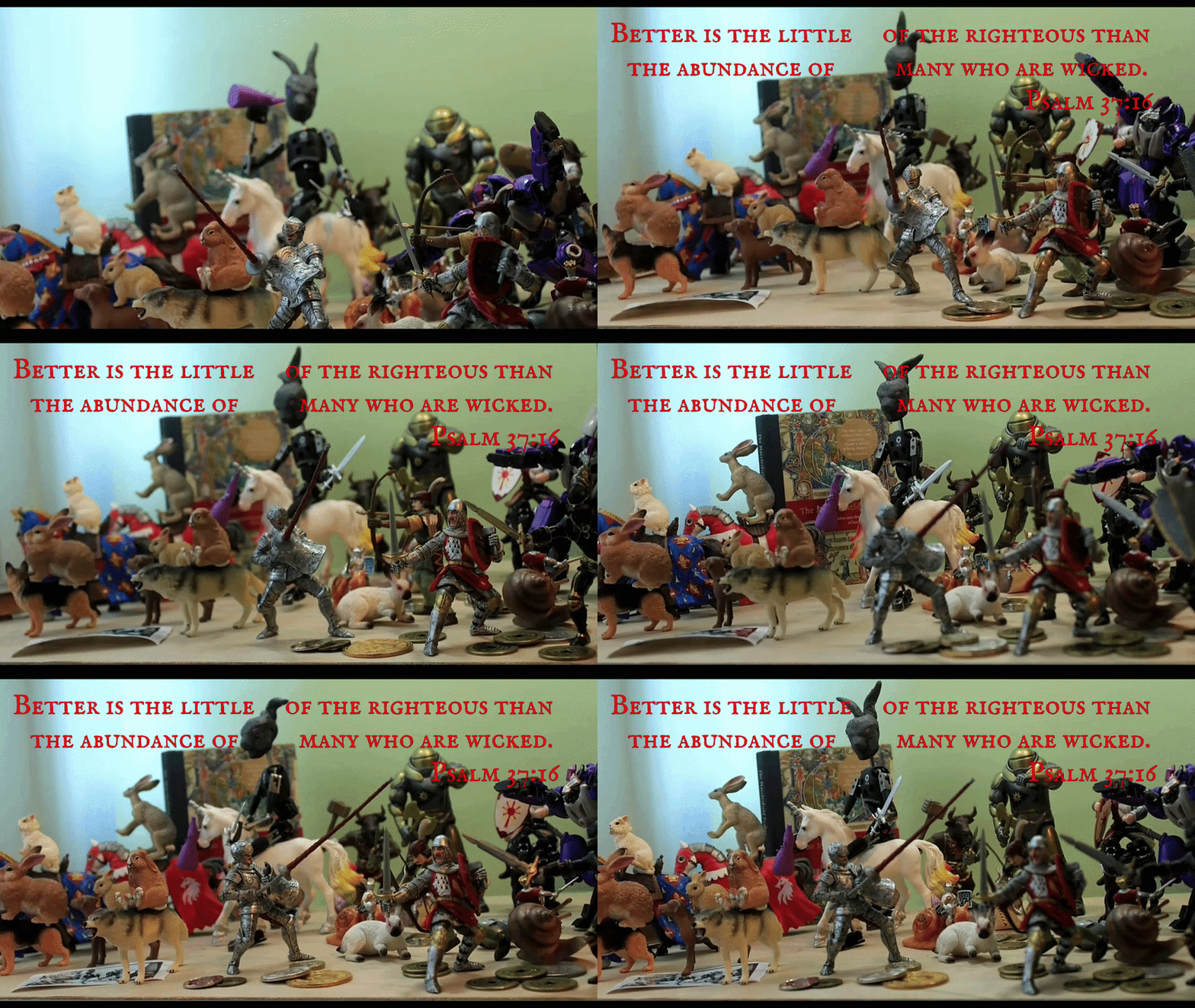
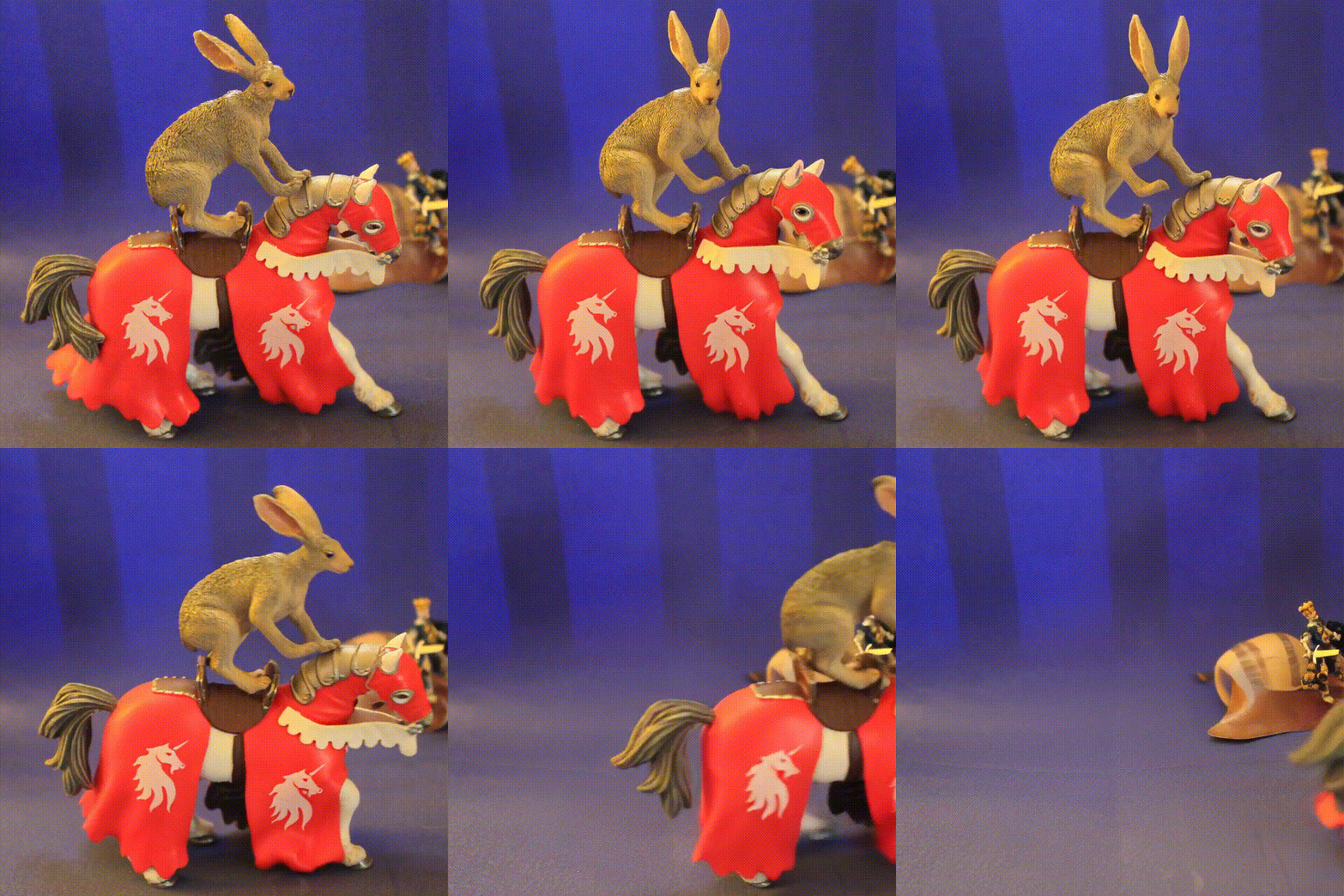
The gif image above is a Stop Motion animation exploring Psalm 37:16,
‘Better is the little of the righteous than the abundance of many who are wicked’, it features righteous poor rabbits, horses and dogs and wickedly abundant human aggressors.
This is my understanding of antithetical parallelism in the Macclesfield Psalter, a contrast of ideas. It interests me that Large Language Models seem to have a tendency towards the robotic repetition of this type of antithetical parallelism, in the form of ‘not X but Y’. I have even seen complaints about it on social media:
‘The two biggest culprits that make AI generated copy hard to read is the over reliance on two key writing styles:
Anaphora: where each sentence starts with the same word in a rhyming pattern.
Antithetical Parallelism: it’s not X, it’s Y.
ChatGPT is the worst for this but most AI does it.
Here’s how to remove it – simply add this to your prompt or custom instructions:
“Critical: avoid all instances of anaphora and rhyming patterns of three. Also avoid antithetical parallelism (it’s not x, it’s y; it not, it’s not, it is;etc) and instead frame positively” (Gordon, n.d).
But I am not convinced this would work judging by my previous experiments with lipograms, LLMS do not follow such rules well, instead they revert to probability.
Mary Carruthers writes “Manuscript decoration is part of the painture of language, one of the gates to memory, and the form it takes often has to do with what is useful not only to understand a text but to retain and recall it too” (Carruthers, 281, 1990). Such complex threads of commentary and cognitive intervention are new to me and have made me rethink my own assumptions about Medieval texts and images as simple, dogmatic or one dimensional.
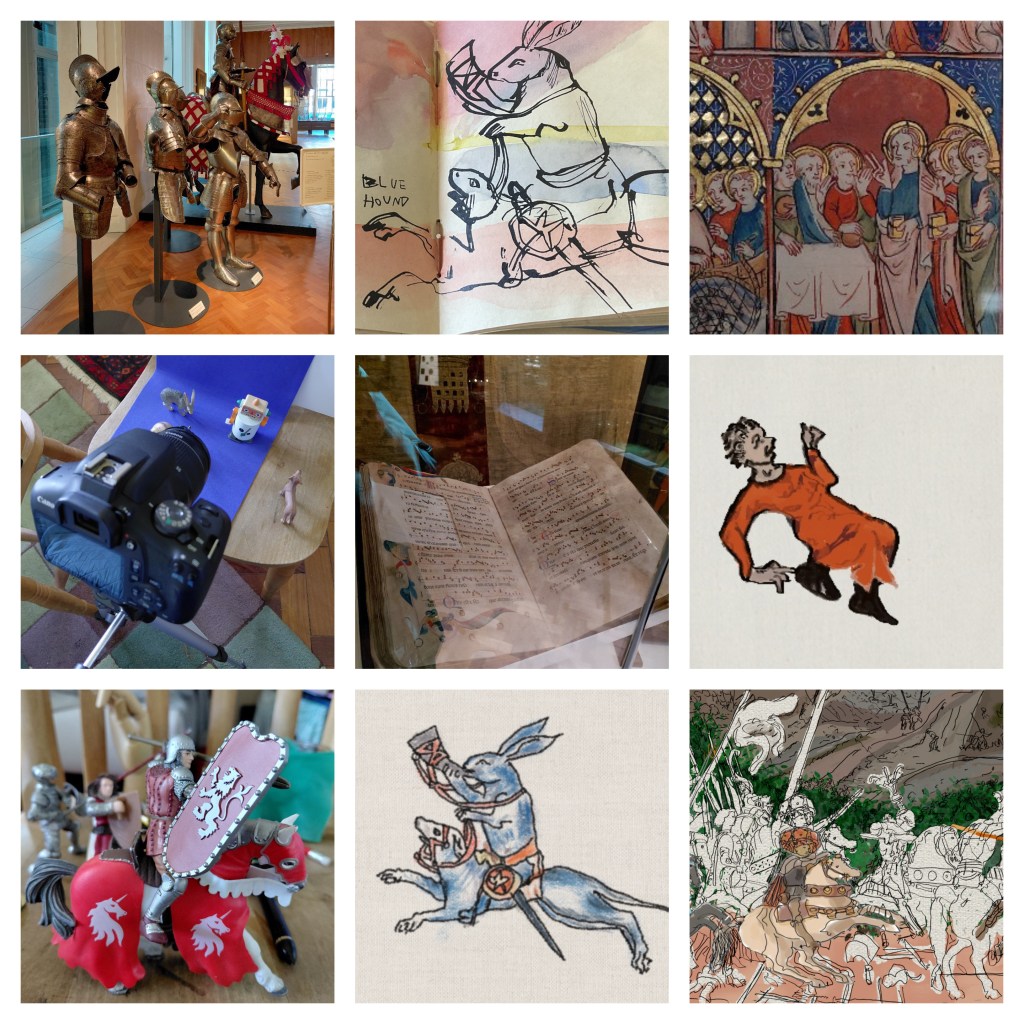
Below, Rabbit leads the hunt.
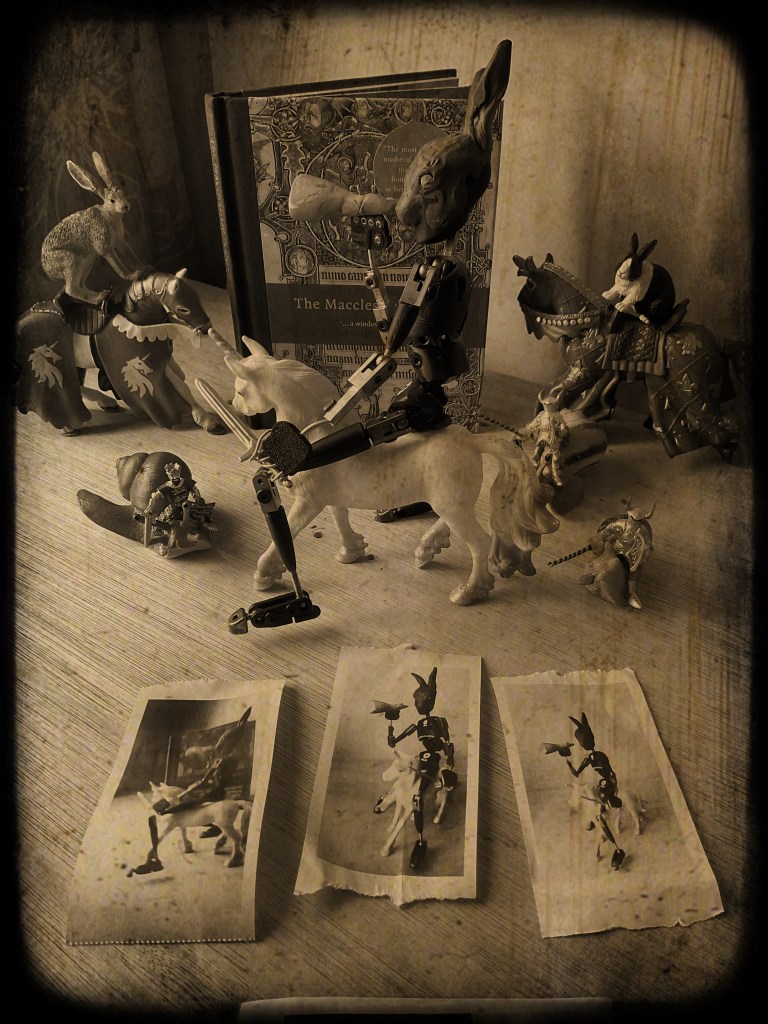
The Macclesfield Psalter was produced in East Anglia ‘around 1330, when the region was one of the foremost artistic centres of Europe. The margins are populated with charming, often bizarre illustrations, combining religious imagery and depictions of everyday life with bawdy humour and grotesque creations. In this fantasy world, men are attacked by giant snails and enormous fish, while rabbits joust, play the organ or ride dogs. These riotous miniatures highlight the place of laughter in the lives of medieval people, even as a part of religious experience’ (BBC Online, 2014).
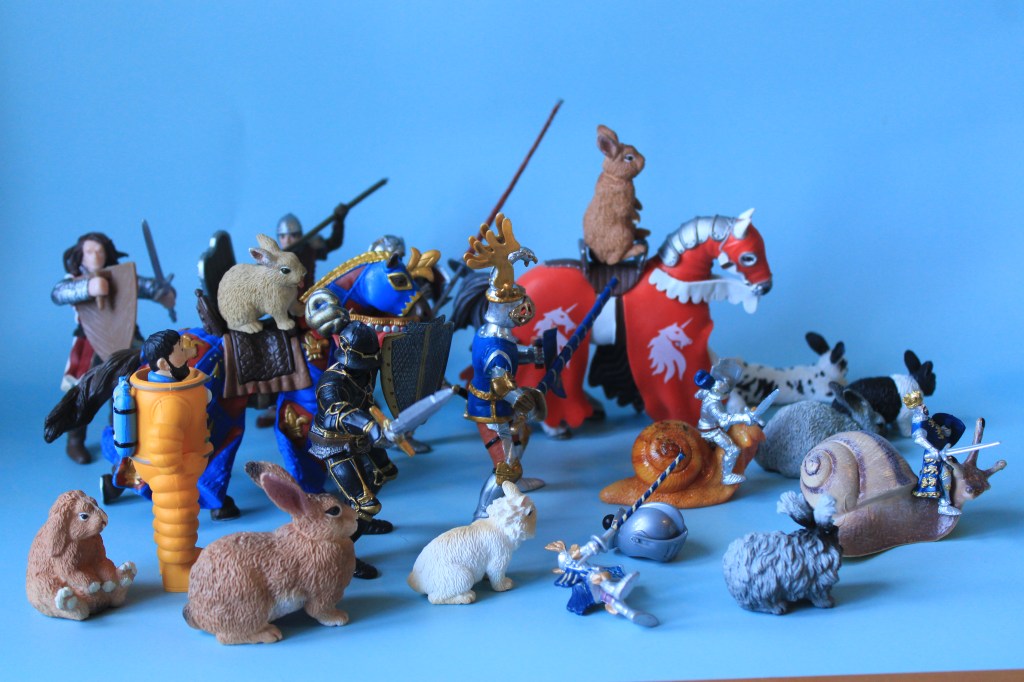
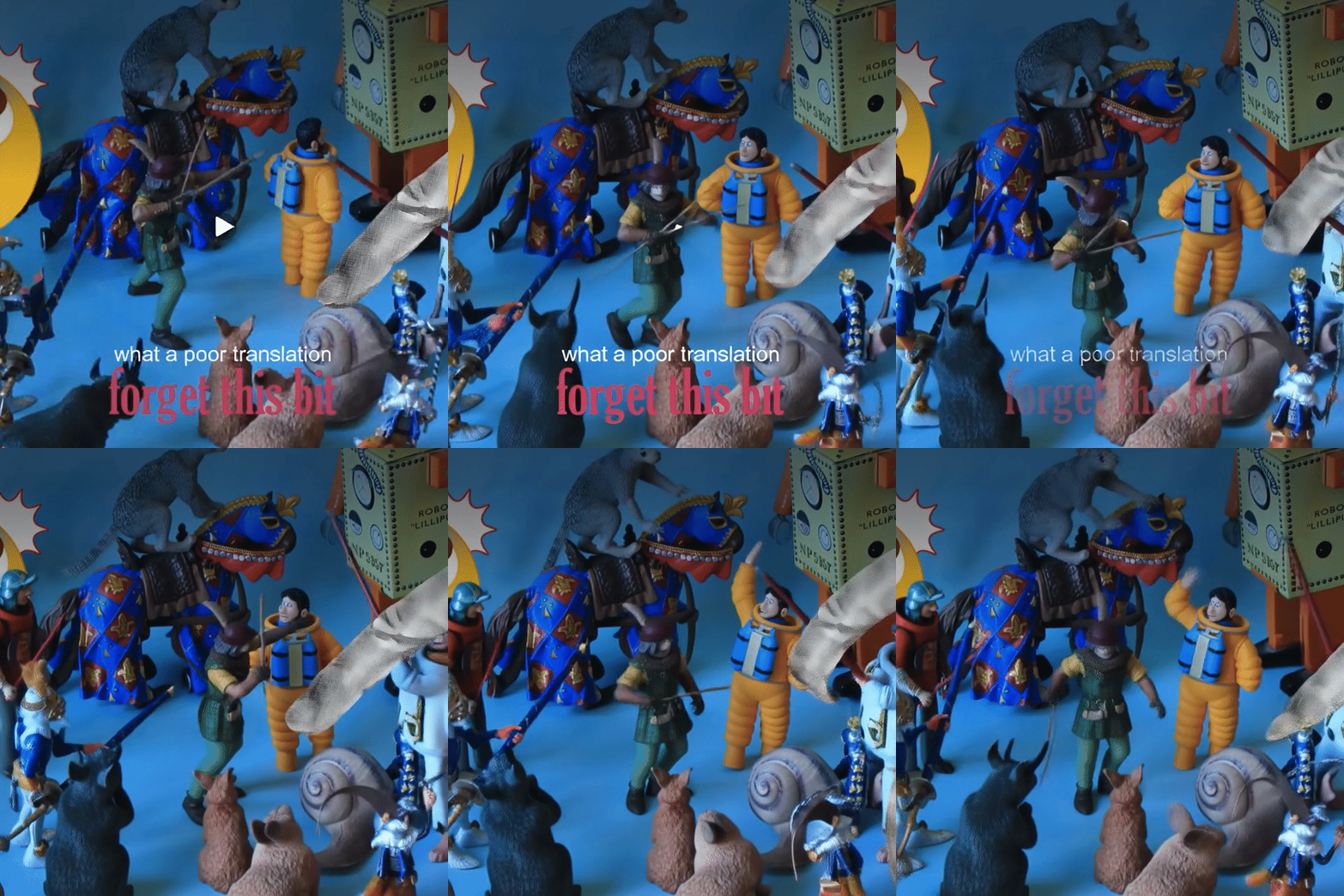
I have tried to enact the inversion of power structures and meta fictional margins and memory devices the Psalter deploys. The image above is a scene I created with toys and an animation armature, the image has some grunge effects (not AI) and photos taken with a lof-fi children’s camera. Evoking the rhyming thought of parallelism found in the Psalter is an interesting visual and animation challenge, but also the echoing motives, metaphors, zoomorphism and animism/personification of objects with thoughts, which has a perhaps surprising resonance with posthumanism.
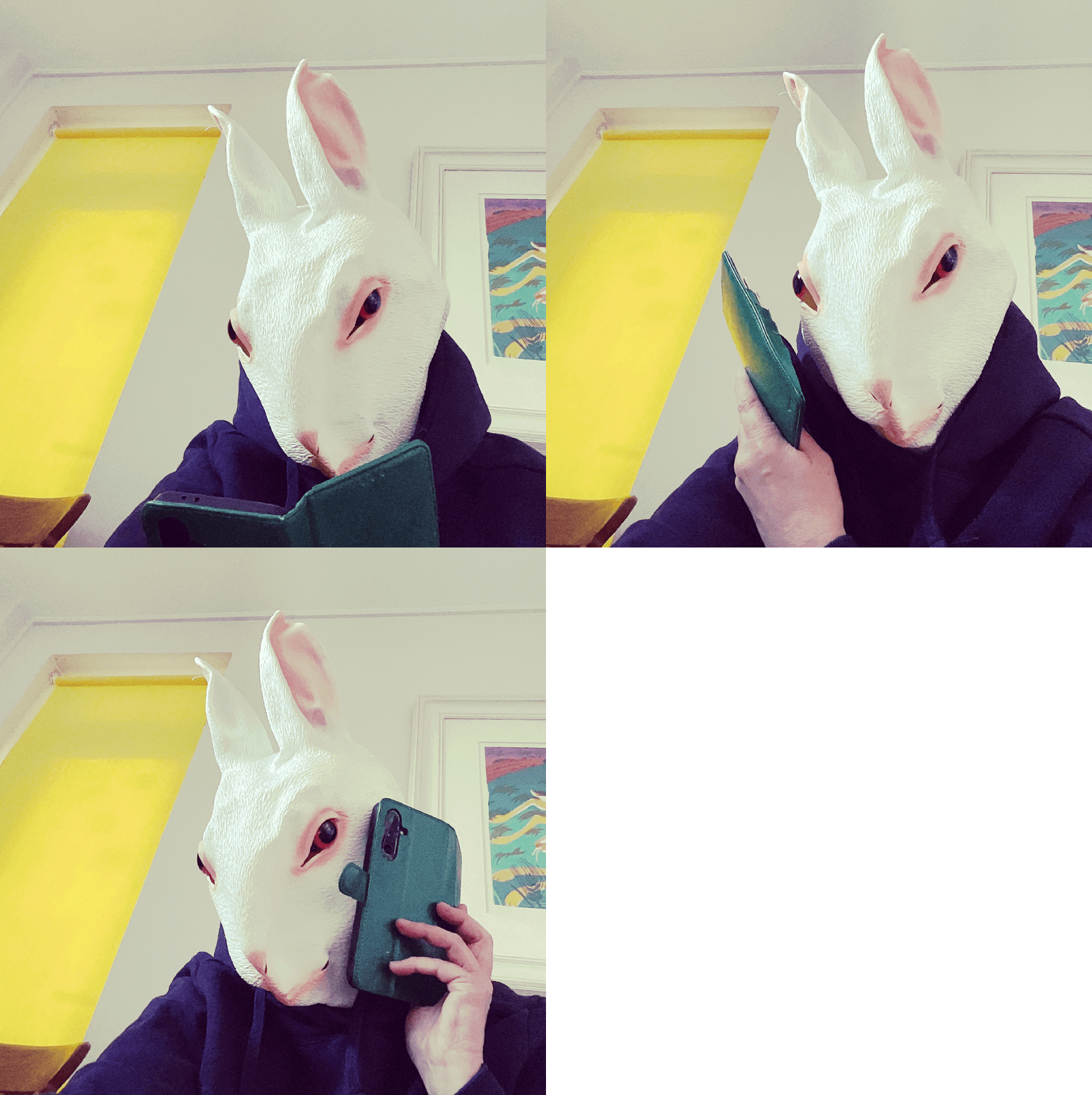
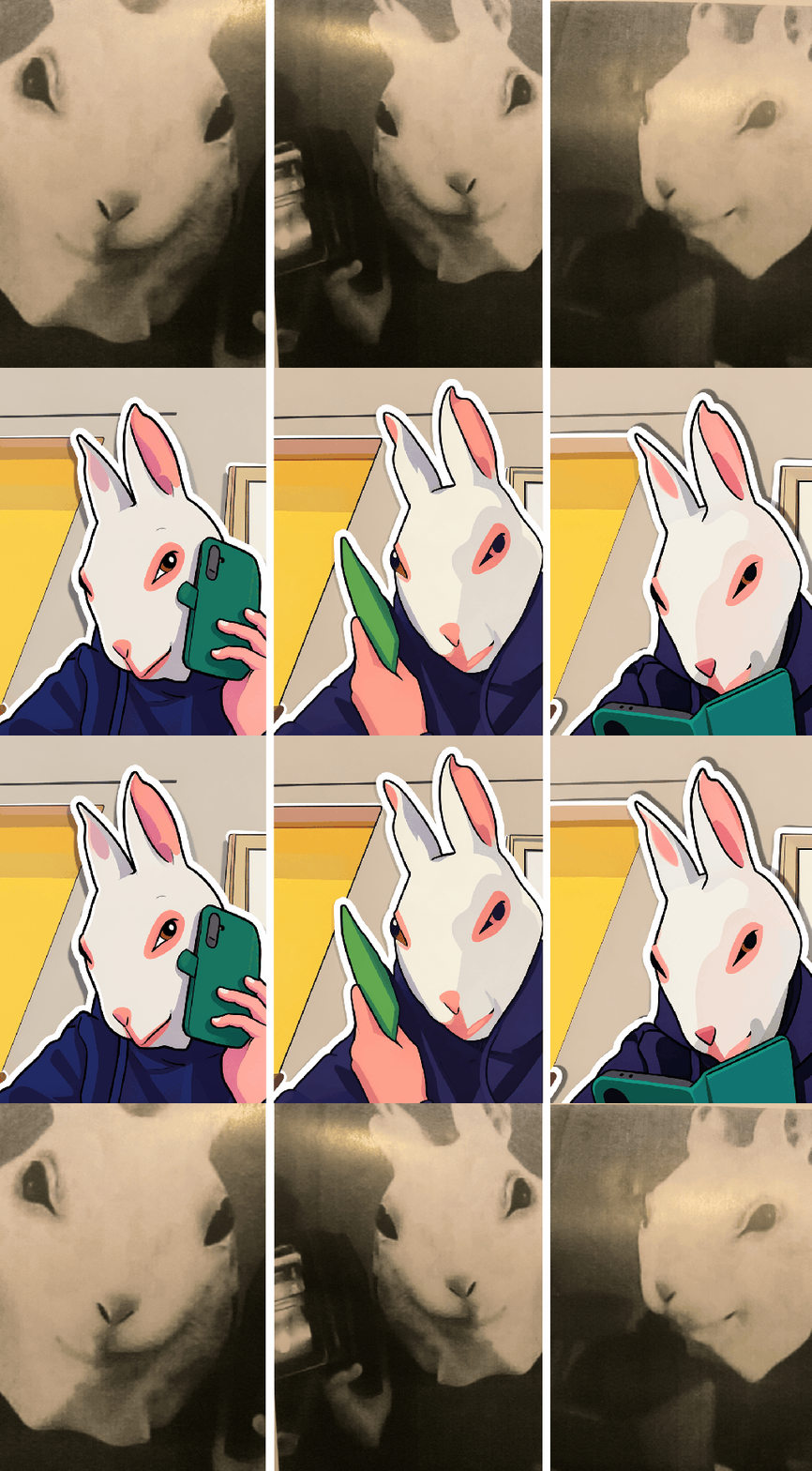
Above, self portrait as Macclesfield Psalter Rabbit, the protagonist of the marginalia; the head is a latex mask I took photos of myself wearing with a lo-fi instant print children’s camera, the cartoon like version is a self portrait with the mask processed via an AI filter app. Both sets of images draw upon the Macclesfield Psalter and the idea of artificial memory. To be clear, I am not using Generative AI as a ‘tool’ or because I think it is better at drawing or thinking than I am (I don’t), rather it is present in some of this work as an opportunity to interrogate the ideologies of vision and memory present between and within the 14th to the 21st Centuries as a form of parallelism/antithetical parallelism.
In relation to the images which arise from machine learning processes, Impett and Offert suggest the need for new methods of investigating ‘basic questions from the fields of art history and urbanism’ taking ‘into account the epistemic entanglement of a model and its applications’ in recognition that ‘the visual ideologies of research datasets and training datasets become entangled’ (Impett & Offert, 2023).
While working with these Medieval images and texts I am confronted by the broader ideological nature of visual culture and the assumptions embedded in this moment of Generative AI saturation. AI technology is almost always presented as the peak of technological advancement and sophistication, but the Macclesfield Psalter and other such ‘multimedia’ texts challenge this assumption, in particular the sophisticated meta-texts of the marginalia, which address critical, operational and religious discourse while also augmenting the psalms instigating heightened mechanisms of memory and intertextual games. Questions of industrialisation and complex supply chains for art production are also raised by these illuminated manuscripts, contradicting our common conception of linear narratives of progress and extraction, particularly in terms of mediation. The gif is of course, ironically, even when mediated via machine learning, a highly reductive form, low on complexity rather than offering the escalated layering and multiple simultaneous threads of the Macclesfield Psalter.

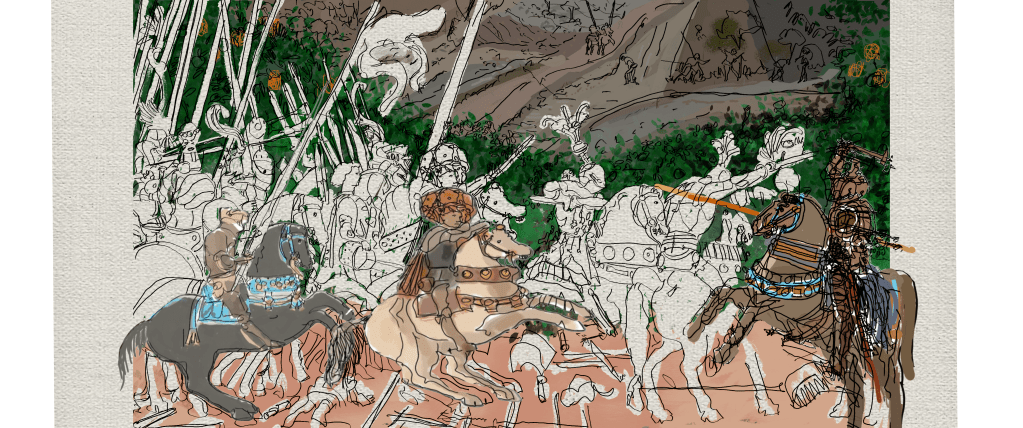
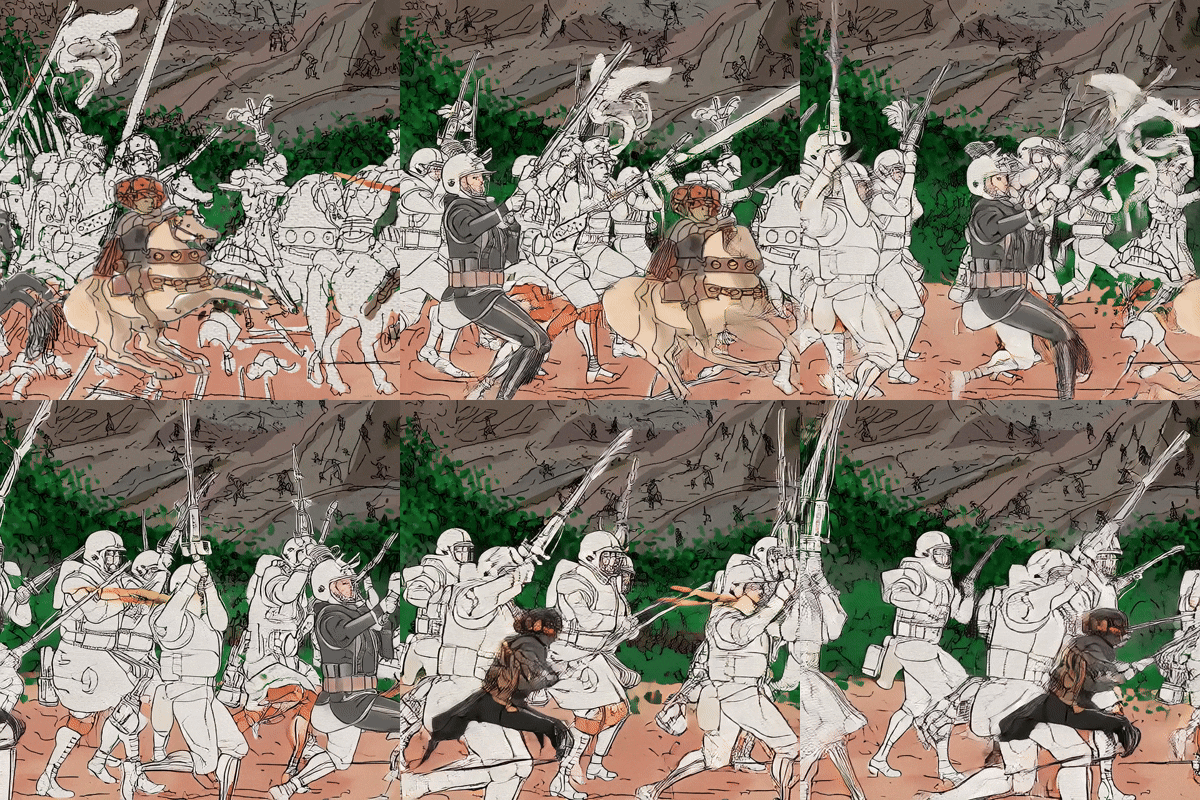
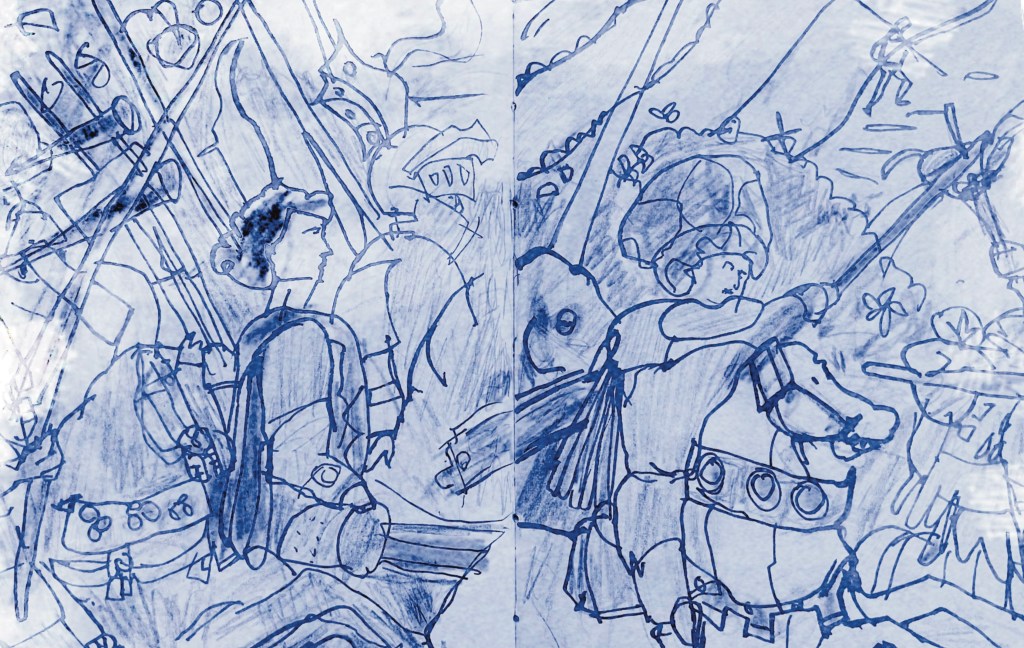
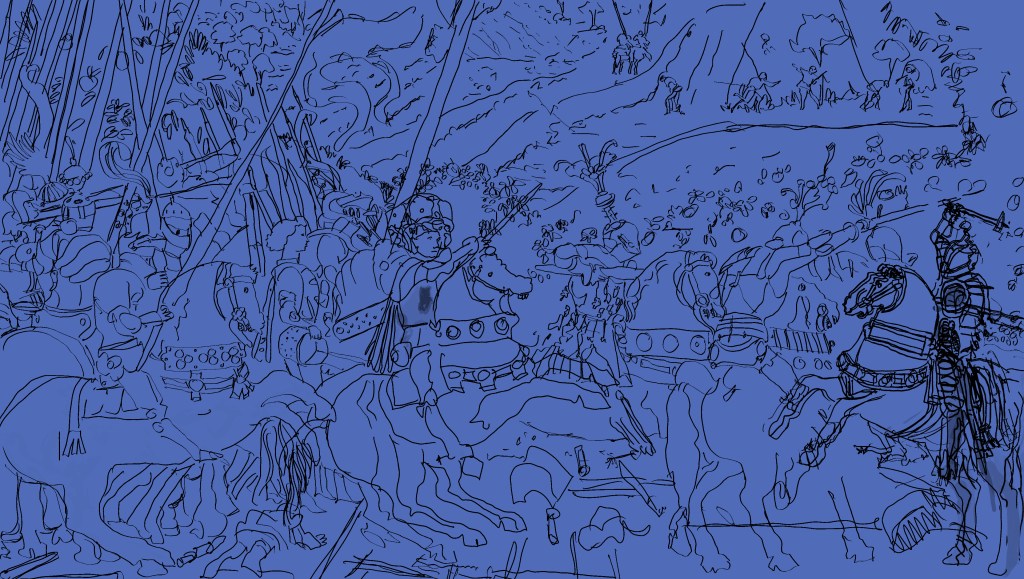
My drawing of Uccello’s Battle of San Romano processed by an AI image to video application, the algorithm has added guns and modern military weapons and uniforms, revealing the dominant patterns of representation such systems draw upon, Impett notes how poor AI systems are at representing pre photographic and pre Fordist culture.
‘imagine trying to adapt these algorithms for early modern European painting; it becomes clear that the categories of objects being detected (e.g. Polaroid Camera, iPod, Model T), and indeed the very notion of object detection, are bound up with a (post-) Fordist image world in which pictures are largely made up of industrially manufactured consumer goods, rather than, say, Albertian istorie (narrative painting)’ Impett, 12, 2024.
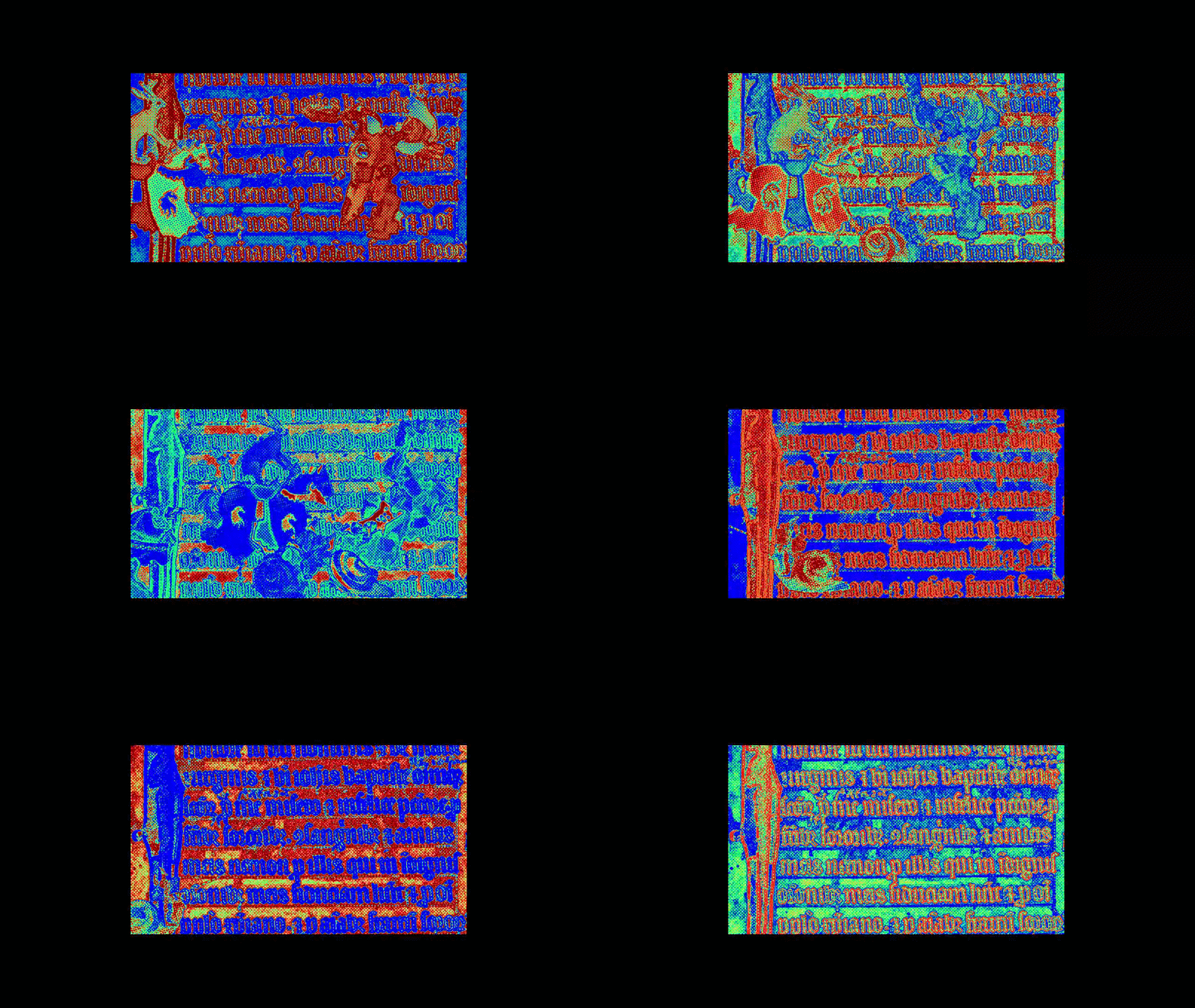
Above and below, Gif versions of image to video algorithms used on my scenes from marginalia.
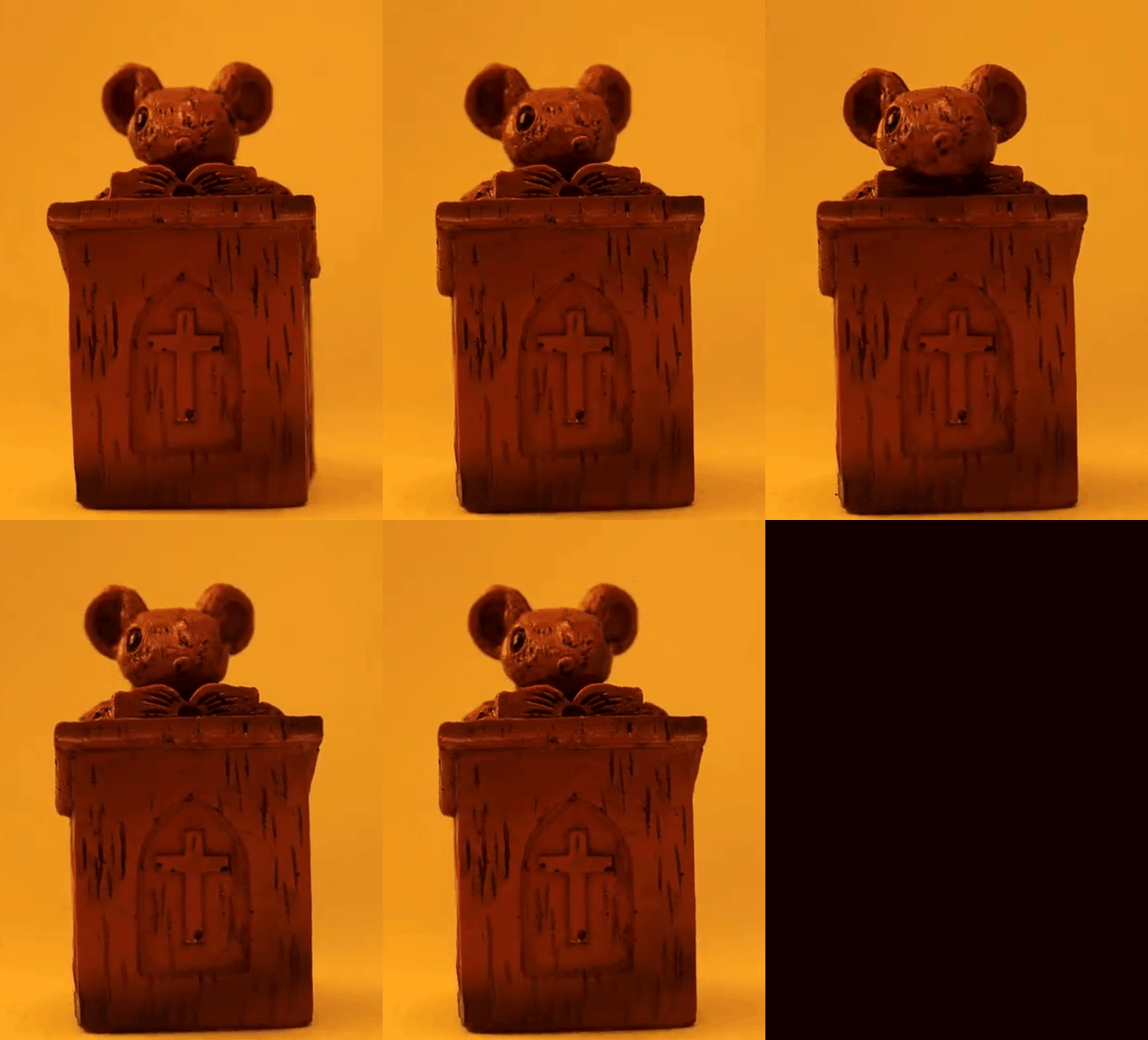
Above, characters from the Macclesfield Psalter, with ongoing notes, animated gif.
Fighting Snail, above, stop motion animated via my studies at the Aardman Academy.
In 2018 Researchers at the MIT media lab trained ‘Norman’ an algorithm to perform image captioning with ‘a popular deep learning method of generating a textual description of an image. We trained Norman on image captions from an infamous subreddit (its name is redacted due to its graphic content)’ Cebrian et al, 2018. The algorithm would interpret innocuous ink blots as acts of murder and horror film intensity.
There is little documentation of the project, which seemed designed to reinforce the construct of ‘data bias’, deliberately using extremely violent data as if it was a niche form of representation and not, arguably the ideological basis of extractive AI industries, whose impact on the environment and communities living near data centres and lithium mines is now well known (see Valdivia, 2024).
The algorithm I have used here manifests a degree of Ballardian behavioural conditioning towards video game levels of aggression, which goes above and beyond the idea of ‘biased’ data sets and is reminiscent of wider game culture (when it manifests as misogynist and violent) and extreme AI CEO identity, such as Mark Zuckerberg, infamous for challenging Musk to a cage fight. The original painting does not animate violence in this way and is instead still, materially grounded, seeming like a moment of reflection within a very carefully constructed formal space. Uccello does not invoke a need for ‘more masculine energy’ as Zuckerberg does, but this short film seems to fulfil that intention, contrived and ontologically questionable as it may be.
Above, montage of image to video scenes, I plan to use role play and real people to create a re-enactment of marginalia, via Tableaux Vivant. To me the AI animations seem deadeningly bereft of vitality, lifeless for all their movement, limited compared to the drawings in medieval marginalia; it will be interesting to see how other people interpret and embody the ideas, characters and inverted norms of power and action found in the Macclesfield Psalter.
Forthcoming talk:
Dr Eleanor Dare will talk about their research for the Medieval Ideas Creative Laboratory Artist’s Bursary at the University of Cambridge. The project has enabled Eleanor to engage people with medieval and contemporary cultures via arts practice, so that we learn something new about our diverse understandings of intelligence (and its perceived absence) and it’s long standing relationship to wider historical, animal and material forces. Eleanor has been researching artificial and wider constructs of intelligence since 2005 and will also talk about their work convening the Cambridge Data Schools: (https://www.cdh.cam.ac.uk/dataschools/) in which participants are encouraged to investigate AI Infrastructures and to grasp the impact of AI on the environment as well as the cognitive capacity of individuals who become reliant upon it. Participants in this session will be encouraged to proactively engage with the Macclesfield Psalter before and during the session, to consider the differences as well as the similarities in how we frame intelligence between the 14th Century and the 2020s.
Open questions:
* In your opinion, are the environmental and ethical costs of Generative AI worth it? If so, what does Generative AI contribute which outweighs the well-known problems?
* Spend some time looking at the Macclesfield Psalter online:
https://qi.fitzmuseum.cam.ac.uk/illuminated/manuscript/discover/the-macclesfield-psalter
What do you notice about the imagery in the margins (the marginalia at the sides and the bottom of the main text), who or what is framed as intelligent, powerful or important?
There is no right or wrong answer. Please do not use Generative AI to answer this question, use your powers of observation, curiosity and intelligence 🙂
Readings which might support these questions:
Crawford, Kate (2018) Anatomy of an AI System. Diagram available here: https://anatomyof.ai/img/ai-anatomy-map.pdf
Estampa (2024) Cartography of generative AI. Diagram available here:https://cartography-of-generative-ai.net/
Impett, Leo (2024) Digital Art History as Critical AI. The Art Bulletin, 106(2), 11–14. https://doi.org/10.1080/00043079.2024.2296270
Impett, Leo, and Offert, Fabian (2023) There is a Digital Art History, https://arxiv.org/abs/2308.07464
Nataliya Kosmyna, Eugene Hauptmann, Ye Tong Yuan, Jessica Situ, Xian-Hao Liao, Ashly Vivian Beresnitzky, Iris Braunstein, Pattie Maes (2025,)Your Brain on ChatGPT: Accumulation of Cognitive Debt when Using an AI Assistant for Essay Writing Task, https://arxiv.org/abs/2506.08872
Salvaggio, Eryk (2024) LAION-5B, Stable Diffusion 1.5, and the Original Sin of Generative AI, Tech Policy Press. Available here:https://www.techpolicy.press/laion5b-stable-diffusion-and-the-original-sin-of-generative-ai
Zewe, Adam (2025) Explained: Generative AI’s environmental impact,https://news.mit.edu/2025/explained-generative-ai-environmental-impact-0117 MIT News
Main References
BBC Online (2014) The Macclesfield Psalter, a History of the World/ objects.https://www.bbc.co.uk/ahistoryoftheworld/objects/_ab31pVtQzClDL56jMuROQ
Carruthers, Mary (1990) The Book of Memory: a study of memory in medieval culture, Cambridge University Press.
Facsimile Finder (2026) Macclesfield Psalter,https://www.facsimilefinder.com/facsimiles/macclesfield-psalter-facsimile
Fitzwilliam Museum (2026) Folio The Macclesfield Psalter Discovery.
Gordon, Stu (n.d) Facebook post, https://www.facebook.com/groups/evolutionunleashedai/posts/26545093385111728/#
Impett, Leo (2024) Digital Art History as Critical AI. The Art Bulletin, 106(2), 11–14. https://doi.org/10.1080/00043079.2024.2296270
Impett, Leo, and Offert, Fabian (2023) There is a Digital Art History, https://arxiv.org/abs/2308.07464
Yanardag, Pinar, Manuel Cebrian, & Iyad Rahwan (2018) ‘NORMAN: World’s first psychopath AI’, MIT Media Lab.
Uccello, Paolo (1438-1440) Niccolò Mauruzi da Tolentino at the Battle of San Romano, left panel (probably c. 1438–1440). Tempera with walnut oil and linseed oil on poplar, 182 × 320 cm. National Gallery, London
Valdivia, A. (2024). The supply chain capitalism of AI: a call to (re)think algorithmic harms and resistance through environmental lens. Information, Communication & Society, 1–17. https://www.tandfonline.com/doi/citedby/10.1080/1369118X.2024.2420021?scroll=top&needAccess=true

